Affiliate Marketing for Ecommerce: A Guide to Growing Online Sales
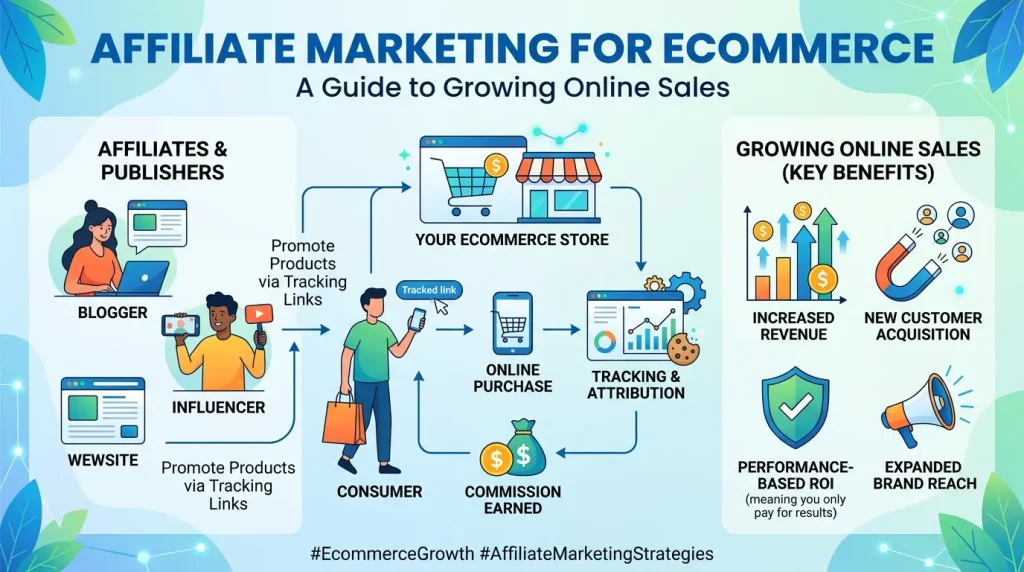
Affiliate marketing for ecommerce is a performance-based strategy that helps online stores increase sales by partnering with affiliates, creators, bloggers, and publishers. This guide explains how ecommerce affiliate marketing works, how to create an affiliate program, choose the right partners, track affiliate sales, and build a profitable long-term strategy.
What Is Affiliate Marketing for Ecommerce?
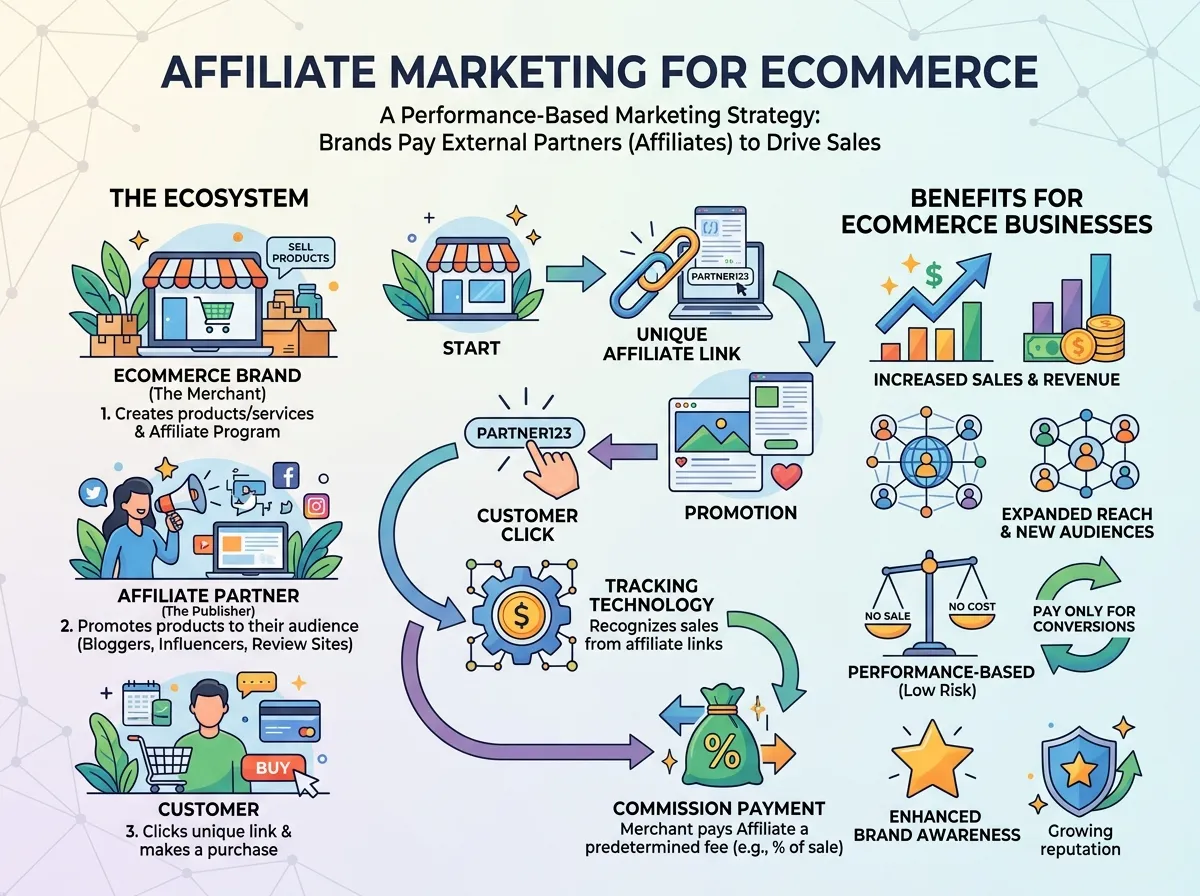
Affiliate marketing for ecommerce is a performance-based marketing strategy where online stores partner with individuals, creators, bloggers, influencers, publishers, or other businesses to promote their products. Affiliates receive a commission when their promotional efforts generate a qualifying sale.
The process is relatively simple. An ecommerce business creates an affiliate program and provides partners with unique tracking links or promotional codes. Affiliates share these links through websites, social media, videos, email newsletters, product reviews, and other channels. When a customer clicks an affiliate link and completes a purchase, the affiliate receives a commission.
Unlike traditional advertising, affiliate marketing allows ecommerce businesses to connect marketing costs directly to measurable results. Instead of paying for every impression or click, the business generally pays a commission after a tracked conversion.
This makes affiliate marketing particularly useful for online stores that want to expand their reach, attract new customers, and increase revenue while maintaining better control over acquisition costs.
How Does Ecommerce Affiliate Marketing Work?
Ecommerce affiliate marketing involves several participants: the merchant, affiliate, customer, and sometimes an affiliate network or tracking platform.
The merchant creates an affiliate offer with commission terms and promotional guidelines. The affiliate joins the program and receives a unique tracking link. The affiliate then promotes the merchant’s products to an audience that may be interested in those products.
When someone clicks the link and purchases a product, the tracking system attributes the transaction to the appropriate affiliate. The merchant can then approve the transaction and pay the agreed commission.
For example, imagine an online clothing store selling running shoes. A fitness blogger publishes a detailed review of several running shoes and includes an affiliate link to the store. A reader clicks the link, visits the store, and purchases a pair of shoes. The affiliate tracking system records the referral, and the blogger earns a commission.
The exact tracking and attribution process can vary depending on the affiliate software, network, cookie duration, and program rules.
Why Is Affiliate Marketing Important for Ecommerce Businesses?
Affiliate marketing can give ecommerce brands access to audiences they may not reach through their own marketing channels. Bloggers, influencers, review websites, content publishers, and niche communities can introduce products to potential customers who already trust their recommendations.
Another advantage is performance-based spending. Because commissions are connected to tracked outcomes, businesses can establish clearer relationships between affiliate costs and generated sales.
Affiliate marketing can also diversify customer acquisition. An online store that relies heavily on paid search or social advertising can use affiliate partnerships to build another source of qualified traffic and revenue.
However, success is not automatic. A profitable program requires appropriate commission structures, reliable tracking, relevant partners, good promotional materials, and ongoing performance analysis.
How to Build an Ecommerce Affiliate Program
Creating effective ecommerce affiliate programs starts with defining clear business objectives. Before recruiting affiliates, determine whether the primary goal is increasing sales, attracting new customers, promoting specific products, entering new markets, or improving overall brand awareness.
Next, establish your commission structure. Your commission should be attractive enough to motivate affiliates while still protecting your profit margins. The appropriate rate depends on your product category, average order value, customer lifetime value, and operating costs.
You should also define your attribution rules, cookie duration, payment schedule, eligible products, refund policies, and promotional restrictions before launching the program.
The next step is selecting affiliate software or an affiliate network. Your technology should provide reliable tracking, reporting, commission management, and integrations with your ecommerce platform.
Finally, create an onboarding process that gives affiliates everything they need to begin promoting your products, including product information, images, links, discount codes, brand guidelines, and campaign ideas. Shopify’s current guidance similarly emphasizes setting goals, selecting tools, recruiting and onboarding affiliates, establishing commission structures, and tracking results.
Affiliate Marketing for Online Stores: Finding the Right Affiliates
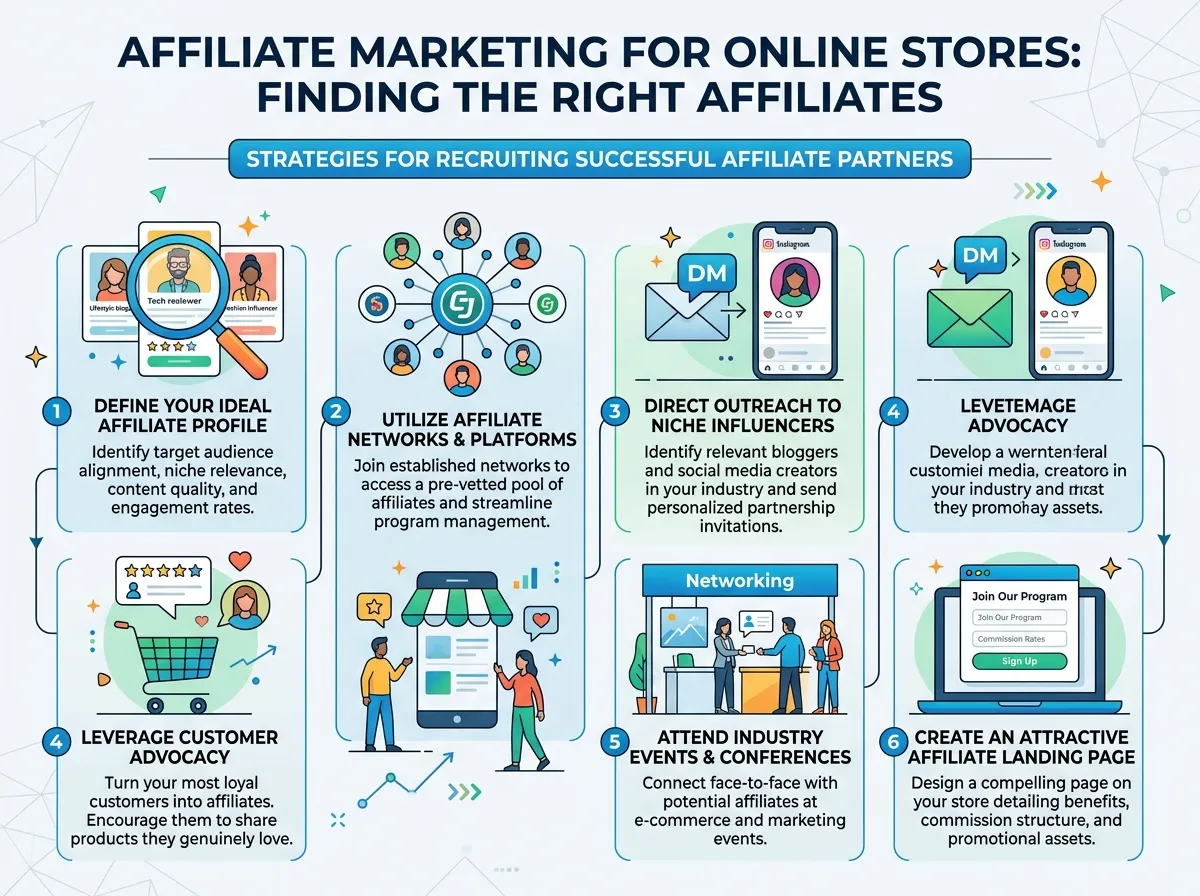
Affiliate marketing for online stores works best when businesses focus on relevance instead of simply trying to recruit as many affiliates as possible.
The ideal affiliate should have an audience that overlaps with your target customers. For example, a skincare brand may benefit from beauty bloggers, skincare creators, dermatology-focused publishers, and lifestyle influencers. A sports equipment store may prefer fitness creators, athletes, sports bloggers, and product-review websites.
Audience quality is often more important than follower count. A smaller creator with a highly engaged niche audience may generate more valuable customers than a large account whose audience has little interest in your products.
You should also evaluate the type of content an affiliate creates, the quality of their website or social channels, their engagement levels, and whether their promotional style matches your brand. Understanding the different ways businesses can evaluate creator campaigns can also help when selecting potential partners. Learn more about how to measure influencer marketing success and identify the metrics that matter when evaluating promotional partners.
Building genuine relationships with high-performing affiliates can encourage them to create better content and continue promoting your products over time.
Developing an Ecommerce Affiliate Strategy
A strong ecommerce affiliate strategy should go beyond simply providing affiliate links.
Start by identifying your highest-priority products. Affiliates are more likely to promote products that have strong reviews, competitive pricing, attractive margins, and clear customer benefits.
Next, create promotional assets that make affiliate promotion easier. Product images, banners, videos, product descriptions, comparison information, sample content, and discount codes can help affiliates produce better campaigns.
You can also create different commission levels based on performance. For example, affiliates who consistently generate higher sales volumes may receive increased commissions or exclusive promotional opportunities.
Seasonal campaigns can also strengthen your strategy. Major shopping periods, product launches, holiday promotions, and limited-time offers can give affiliates compelling reasons to promote your products.
Most importantly, review performance regularly. Track which affiliates generate sales, which products they promote, which campaigns convert, and where new opportunities exist.
Affiliate Marketing for Ecommerce Businesses: Using Content to Drive Sales
Affiliate marketing for ecommerce businesses becomes particularly powerful when combined with content marketing.
Affiliates can create product reviews, buying guides, tutorials, comparisons, gift guides, social media posts, videos, and other content that introduces products to potential customers.
For example, a technology website might publish a comparison of several wireless headphones and include affiliate links to each product. A beauty creator might publish a skincare routine featuring products from an ecommerce brand. A home improvement blogger could create a guide explaining which tools homeowners need for a particular project.
This type of content can support customers during the research stage of the buying journey. Instead of simply seeing an advertisement, consumers can discover products through educational or review-based content.
For ecommerce brands, this can create a valuable combination of exposure, referral traffic, product discovery, and sales.
Building Strong Ecommerce Affiliate Partnerships
Successful ecommerce affiliate partnerships should be treated as long-term relationships rather than one-time transactions.
Communicate regularly with your top affiliates and provide them with information about new products, upcoming promotions, seasonal campaigns, and exclusive offers. Ask what resources would help them create better content and identify obstacles that may be limiting their performance.
Exclusive discount codes can also give affiliates something valuable to offer their audiences. Product samples, early access, custom landing pages, and increased commissions for specific campaigns can further strengthen relationships.
Influencer and creator partnerships can also become an important part of an affiliate program, particularly for ecommerce brands that depend on product discovery and social recommendations. Businesses can explore mastering influencer marketing to better understand how influencer campaigns can complement broader digital marketing efforts.
It is also important to recognize your best-performing partners. Affiliates who consistently generate profitable customers should receive additional attention and support.
The goal is to create a situation where both the ecommerce business and affiliate benefit from continued collaboration.
Increasing Affiliate Sales for Ecommerce
Affiliate sales for ecommerce can be improved by optimizing both the affiliate program and the customer experience.
Start with the products being promoted. Affiliates will have an easier time generating conversions when products have competitive prices, strong reviews, clear product descriptions, high-quality images, and a straightforward checkout process.
Your website also matters. Even an excellent affiliate can struggle if the landing page loads slowly, lacks important product information, or makes checkout difficult.
You can improve affiliate sales by giving partners product-specific landing pages, promotional codes, comparison resources, seasonal offers, and creative assets. Testing different offers can help identify what motivates customers to complete purchases.
Performance data should also guide optimization. If an affiliate generates substantial traffic but few sales, investigate whether the problem is the audience, product, offer, landing page, or customer experience.
Creating an Affiliate Marketing Strategy for Ecommerce
An effective affiliate marketing strategy for ecommerce should include clear goals, partner selection, commission management, tracking, content support, and ongoing optimization.
Begin by defining measurable targets. You might want to generate a certain number of monthly affiliate sales, increase new-customer acquisition, promote a particular product category, or expand into a new audience segment.
Then divide affiliates into meaningful groups. You could have content publishers, influencers, coupon websites, review sites, comparison websites, and niche creators. Different affiliate types may require different commission structures and promotional approaches.
Influencer partnerships can be particularly useful when your products depend on visual content, recommendations, or social proof. Some brands are also experimenting with newer forms of digital creators, including virtual influencer branding, as part of their broader promotional strategies.
Measure more than clicks. Important performance indicators can include conversion rate, revenue, average order value, new customers, commission costs, return on investment, and customer lifetime value.
Advanced affiliate programs can also analyze customer journeys and partner performance rather than relying exclusively on last-click sales.
Choosing an Ecommerce Affiliate Network

An ecommerce affiliate network can connect merchants with publishers and simplify important parts of affiliate program management.
Networks may provide affiliate discovery, tracking, reporting, payment management, and program administration. This can be useful for ecommerce businesses that do not have the resources to recruit and manage every affiliate independently.
However, an affiliate network is not always necessary. Larger brands may prefer dedicated affiliate management software or an in-house approach that gives them greater control over partner relationships and data.
When evaluating a network, consider its publisher base, tracking capabilities, integrations, reporting features, fees, payment options, fraud controls, and overall ease of use.
The right choice depends on the size of your ecommerce business and the type of affiliates you want to attract.
Affiliate Marketing Tools for Ecommerce
The right affiliate marketing tools for ecommerce can make program management significantly easier.
Affiliate software can help businesses generate tracking links, monitor clicks and conversions, calculate commissions, manage affiliate accounts, and produce performance reports. Integration with platforms such as Shopify or other ecommerce systems can further automate the process.
When choosing tools, look beyond the number of features. Reliable conversion tracking is essential because inaccurate attribution can create payment disputes and unreliable performance reports.
You should also look for tools that provide useful analytics, automated reporting, commission management, fraud prevention, and integrations with your existing ecommerce and marketing technology.
A good tool should reduce administrative work while giving you enough information to understand which partners and campaigns are generating profitable growth.
Measuring Ecommerce Affiliate Performance
Tracking performance is essential for determining whether your affiliate program is actually profitable.
Start with basic metrics such as clicks, conversions, conversion rate, sales, commissions, and revenue. Then move toward more meaningful business measurements such as new-customer revenue, average order value, customer lifetime value, and incremental sales.
It is also useful to compare affiliate performance by partner type. For example, influencer affiliates may generate strong awareness and first-time purchases, while comparison websites may attract customers who are already close to making a purchase.
Returns and canceled orders should also be considered when calculating affiliate profitability. A program may appear successful based on gross sales but become less attractive after refunds, commissions, and other costs are included.
Regular reporting helps you identify high-performing partners and determine where your affiliate strategy needs improvement.
Common Mistakes to Avoid
One common mistake is focusing entirely on affiliate recruitment without creating a strong customer experience. More affiliates do not necessarily mean more profitable sales.
Another problem is setting commission rates without considering product margins. A commission that looks attractive to affiliates can become expensive if it leaves too little profit after fulfillment, returns, discounts, and other costs.
Poor tracking is another major issue. Every ecommerce business should test affiliate links and conversion tracking before launching campaigns at scale.
Businesses should also avoid ignoring their best affiliates. High-performing partners often need better communication, exclusive offers, and additional resources to continue growing.
Finally, avoid judging your entire program using a single metric. A successful affiliate strategy should be evaluated using sales, profitability, customer quality, conversion performance, and long-term value.
Conclusion
Affiliate marketing for ecommerce gives online stores an opportunity to grow sales by partnering with creators, publishers, bloggers, influencers, and other businesses.
A successful program requires more than affiliate links. Ecommerce businesses need a clear strategy, competitive commissions, reliable tracking, relevant partners, strong promotional resources, and continuous performance optimization.
By developing quality ecommerce affiliate partnerships, choosing suitable tools and networks, and focusing on profitable affiliate sales for ecommerce, brands can build an acquisition channel that supports sustainable growth.
The most effective approach is to treat affiliates as strategic marketing partners rather than simply another source of traffic. When businesses provide the right products, resources, incentives, and support, affiliate marketing can become an important part of a broader ecommerce growth strategy.
Frequently Asked Questions
What is affiliate marketing for ecommerce?
Affiliate marketing for ecommerce is a performance-based strategy where online stores partner with affiliates to promote products. Affiliates earn a commission when their referral results in a qualifying purchase.
How does ecommerce affiliate marketing work?
An ecommerce store provides affiliates with unique tracking links or codes. When customers use these links to make purchases, the affiliate earns a commission based on the sale.
Is affiliate marketing good for online stores?
Yes. Affiliate marketing can help online stores reach new audiences, increase traffic, and generate sales while keeping marketing costs closely connected to actual results.
How do I start an ecommerce affiliate program?
Define your goals, choose products to promote, set commission rates, select affiliate software or a network, and recruit relevant affiliates. Provide promotional resources and test tracking before launching.
What commission should an ecommerce affiliate program offer?
Commission rates depend on factors such as product margins, average order value, competition, and customer value. Choose a rate that is attractive to affiliates while remaining profitable for your business.
What are the best affiliates for ecommerce businesses?
Relevant bloggers, influencers, YouTubers, product reviewers, publishers, and niche content creators can be effective affiliates. Audience relevance and engagement are often more important than follower count.
What is an ecommerce affiliate network?
An ecommerce affiliate network connects online stores with affiliates and often provides tracking, reporting, payment management, and other program management features.
What tools are needed for affiliate marketing for ecommerce?
Common tools include affiliate tracking software, conversion tracking, analytics, reporting systems, and ecommerce integrations. Some businesses also use tools for affiliate recruitment and payment management.
How can I increase affiliate sales for ecommerce?
Recruit relevant affiliates, improve product pages, offer useful promotional materials, test special discounts, and support high-performing partners. Monitor conversion data to identify areas for improvement.
How do I measure the success of an ecommerce affiliate strategy?
Track affiliate revenue, conversions, conversion rate, commissions, average order value, new customers, ROI, and customer lifetime value. Focus on profitability rather than sales volume alone.