How to Measure Influencer Marketing ROI

Measuring influencer marketing ROI means tracking specific metrics—reach, engagement, conversions, and revenue—against your campaign costs. Brands that define clear goals before launch and use proper tracking tools consistently report stronger returns and more defensible marketing budgets.
Influencer marketing has become one of the most debated line items in a marketing budget. Executives want proof it works. Marketers know it does—but struggle to show the numbers. That gap between intuition and evidence is exactly where influencer marketing ROI becomes critical.
The challenge isn’t just picking the right creator. It’s knowing what to measure, when to measure it, and how to translate social media activity into business outcomes. Likes and comments are easy to count. Revenue impact is harder. But with the right framework, it’s entirely achievable.
This guide breaks down everything you need to know about measuring influencer marketing ROI—from setting the right goals before a campaign launches, to tracking conversions after it ends. You’ll also find practical tools, formulas, and benchmarks to help you make smarter decisions with your influencer budget.
Whether you’re running your first campaign or refining an existing program, this post gives you a clear, structured path from spend to proof.
What Is Influencer Marketing and Why Does ROI Matter?
Before diving into measurement, it helps to understand what influencer marketing actually involves—and why so many brands struggle to prove its value.
At its core, influencer marketing is a strategy where brands partner with individuals who have established credibility and audiences in a specific niche. These individuals—influencers—promote products or services to their followers in exchange for payment, free products, affiliate commissions, or a combination of all three.
What is influencer marketing in practice? It’s a sponsored Instagram Reel from a fitness creator showing a protein powder brand. It’s a YouTube review from a tech creator unboxing a new laptop. It’s a TikTok series from a travel creator documenting their stay at a boutique hotel. The format varies; the mechanism is the same—trusted voices drive awareness and action.
According to Influencer Marketing Hub’s 2024 Benchmark Report, the influencer marketing industry is expected to reach $24 billion globally by the end of 2024, up from $21.1 billion in 2023. That growth signals confidence—but also raises scrutiny. As budgets grow, so does pressure to justify them.
ROI—return on investment—is the ratio of profit (or value) gained relative to what was spent. In influencer marketing, this calculation is rarely straightforward because the value delivered spans multiple dimensions: brand awareness, audience trust, content creation, and direct sales. A single campaign might deliver strong reach but modest conversions, or vice versa. Understanding how influencer marketing works across each of these dimensions is the first step toward measuring it accurately.
Without ROI measurement, brands are flying blind. They may over-invest in creators who look impressive on paper but drive no meaningful business outcomes. Or they may cut effective programs because the results weren’t captured correctly. Either way, the cost is real.
Setting the Foundation: Goals, KPIs, and Campaign Types

Measuring influencer marketing ROI starts before the campaign launches. The single biggest mistake brands make is treating measurement as an afterthought—something to figure out once the content goes live. By then, it’s too late to set up proper tracking.
What goals should you set for an influencer marketing campaign?
Goals determine what you measure. And goals should reflect where the campaign sits in the marketing funnel.
Awareness-stage goals are appropriate for new brands, product launches, or entering new markets. At this stage, the focus is on reach, impressions, and brand search volume. You’re paying for eyeballs and familiarity.
Consideration-stage goals target audiences who already know the brand but haven’t converted. Here, metrics like engagement rate, content saves, profile visits, and website traffic become more relevant.
Conversion-stage goals focus on direct action—sales, sign-ups, downloads, or bookings. These campaigns typically use discount codes, affiliate links, or dedicated landing pages to track behavior directly attributable to the influencer.
Defining this upfront shapes everything that follows: which influencers you partner with, what content they create, and how success is evaluated.
Which KPIs should you track for influencer marketing ROI?
Once goals are set, KPIs (key performance indicators) translate those goals into measurable numbers. Here’s a practical framework:
|
Campaign Goal |
Primary KPIs |
Secondary KPIs |
|---|---|---|
|
Brand Awareness |
Reach, Impressions, Brand Search Volume |
Share of Voice, Follower Growth |
|
Engagement |
Engagement Rate, Comments, Saves |
Sentiment Analysis, Click-Through Rate |
|
Traffic |
Website Sessions, Referral Traffic |
Bounce Rate, Pages Per Session |
|
Conversions |
Sales, Sign-Ups, Downloads |
Cost Per Acquisition, Conversion Rate |
|
Content Value |
Number of Assets Produced, Content Quality |
Usage Rights, Organic Reach of Repurposed Content |
The best influencer marketing strategies tie every KPI back to a business objective—not just a vanity metric. A campaign that generates 5 million impressions but zero website visits may look impressive but contribute little to the bottom line.
How to Calculate Influencer Marketing ROI
The basic ROI formula is straightforward:
ROI (%) = [(Revenue Generated − Campaign Cost) ÷ Campaign Cost] × 100
For example, if you spent $10,000 on an influencer campaign and it generated $35,000 in tracked revenue, your ROI is 250%.
But in practice, calculating influencer marketing ROI requires a few adjustments.
What costs should you include in your influencer marketing budget?
Many brands underestimate total campaign costs by focusing only on the creator fee. A more accurate calculation includes:
- Creator fees (flat rate, commission, gifting value)
- Agency or platform fees (if you use a marketplace or management tool)
- Content production costs (paid ads using influencer content, usage rights licensing)
- Tracking tool costs (UTM setup, affiliate platform fees)
- Internal time (campaign management, briefing, contracting, reporting)
Excluding these costs inflates your apparent ROI. Include them all for an honest picture.
How do you track revenue from influencer campaigns?
Revenue attribution is the most technically demanding part of measuring influencer marketing ROI. The most reliable methods include:
Unique discount codes: Each influencer receives a personalized promo code (e.g., SARAH20). When a customer uses it at checkout, the sale is attributed to that creator. This approach is simple, trackable, and gives influencers a tool to actively promote with urgency.
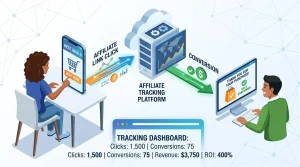
Affiliate links: Using platforms like ShareASale, Impact, or LTK, brands generate unique tracking URLs for each influencer. Every click and conversion is logged at the individual creator level. This works particularly well for content with longer shelf life, like YouTube videos or blog posts.
UTM parameters: UTM codes appended to links (via Google Analytics or similar tools) allow brands to track traffic source, campaign, and medium. For example: yoursite.com/product?utm_source=instagram&utm_medium=influencer&utm_campaign=spring2024&utm_content=sarah_jones
Dedicated landing pages: Creating campaign-specific URLs—such as yoursite.com/sarah—allows precise traffic and conversion tracking per creator.
Post-purchase surveys: Asking customers “How did you hear about us?” captures influence that tracking pixels miss, particularly for new customers driven by awareness campaigns.
Using multiple methods simultaneously gives the most complete picture. Relying on only one risks under-counting real impact.
Metrics That Matter: From Reach to Revenue
Not all metrics are created equal. Some are easy to collect but loosely tied to business outcomes. Others are harder to capture but much more meaningful. Understanding the difference is central to measuring influencer marketing ROI correctly.
Earned Media Value (EMV): Useful but Limited
Earned media value (EMV) is a common metric that estimates the equivalent advertising cost of organic influencer content. For example, if an influencer post received 500,000 impressions and the equivalent paid media CPM (cost per thousand impressions) in your industry is $8, the EMV would be $4,000.
EMV provides a useful benchmark for comparing influencer campaigns to paid media spend. However, it doesn’t capture conversions, sales, or long-term brand impact. Use it as one data point—not the headline number.
Engagement Rate: Quality Over Quantity
Engagement rate measures how actively an audience interacts with content relative to total followers or reach:
Engagement Rate = (Likes + Comments + Shares + Saves) ÷ Reach × 100
Industry benchmarks vary by platform and creator tier:
|
Creator Tier |
Follower Range |
Average Engagement Rate (Instagram) |
|---|---|---|
|
Nano |
1K–10K |
3.69% |
|
Micro |
10K–100K |
2.05% |
|
Mid-Tier |
100K–500K |
1.58% |
|
Macro |
500K–1M |
1.21% |
|
Mega/Celebrity |
1M+ |
0.95% |
Source: Influencer Marketing Hub, 2024
This data reinforces a pattern that surprises many brands: smaller creators often deliver higher engagement. For influencer marketing for small businesses especially, micro and nano-influencers frequently deliver stronger per-dollar ROI than celebrity endorsements.
Cost Per Engagement (CPE) and Cost Per Acquisition (CPA)
CPE = Total Campaign Cost ÷ Total Engagements
CPA = Total Campaign Cost ÷ Total Conversions
These two metrics allow cross-campaign comparison. A creator who charges $5,000 but drives 50,000 genuine engagements (CPE: $0.10) and 200 sales (CPA: $25) may deliver far better value than one who charges $2,000 but generates minimal measurable activity.
How to Find the Right Influencers to Maximize ROI
Campaign measurement only reveals whether a strategy worked. But the outcome often traces back to a more fundamental decision: choosing the right creators from the start.
How to find the right influencers is a question with several practical answers.
Audience alignment beats follower count
The most common (and costly) mistake is prioritizing reach over relevance. A fitness influencer with 2 million followers may have minimal overlap with a B2B software brand’s target buyer. Meanwhile, a niche tech creator with 40,000 engaged subscribers might drive exactly the decision-makers that brand needs to reach.
Before approaching any creator, audit their audience:
- Demographics: Age, gender, location, language
- Audience interests: What other accounts do followers engage with?
- Follower authenticity: Use tools like HypeAuditor or Modash to detect fake followers and inflated engagement
Vet content quality and brand safety
Review a creator’s last 30–60 days of content. Ask: Does the quality align with your brand standards? Do they disclose paid partnerships properly (a legal requirement under FTC guidelines in the US)? Have they made statements or taken positions that conflict with your brand values?
Brand safety due diligence is not optional. One misaligned partnership can undo significant brand-building investment.
Tools for influencer discovery
Several platforms streamline the discovery and vetting process:
|
Platform |
Best For |
Key Feature |
|---|---|---|
|
Modash |
Mid-to-large brands |
Audience quality scoring |
|
Creator.co |
Small businesses |
Self-serve marketplace |
|
Upfluence |
E-commerce brands |
Shopify integration |
|
AspireIQ |
Campaign management |
End-to-end workflow |
|
TikTok Creator Marketplace |
TikTok campaigns |
Native platform data |
Building a Measurement Framework Before You Launch
A measurement framework is a structured plan that documents what you’ll track, how you’ll track it, and what success looks like—before the campaign begins. This section covers how to create an influencer marketing strategy that is measurable from day one.
Step 1: Define your campaign objective and funnel stage
Map every campaign to one of three stages: awareness, consideration, or conversion. This determines which metrics take priority.
Step 2: Select your tracking methods
Based on your objective, identify which tracking methods you’ll implement. Conversion-focused campaigns require affiliate links or unique promo codes set up before content goes live. Awareness campaigns need branded search tracking and share-of-voice monitoring.
Step 3: Establish a baseline
Before the campaign launches, record your current benchmarks: monthly website traffic, conversion rate, brand search volume, social follower count. Post-campaign comparison is only meaningful if you know where you started.
Step 4: Create a reporting template
Document your KPIs, the formula used for each, and the data source. Consistency in reporting allows meaningful comparison across campaigns and creators.
Step 5: Set your attribution window
Decide how long after the campaign ends you’ll track conversions. A 7-day window may capture direct impulse purchases but miss considered buyers who return later. A 30-day window is more generous and typically more accurate for higher-ticket products.
Influencer Marketing Campaign Examples: What Good ROI Looks Like
Abstract frameworks become more useful when grounded in real campaign patterns. Influencer marketing campaign examples from different industries illustrate how ROI varies depending on goal, format, and creator selection.
E-commerce: Flash sale with discount codes
A DTC skincare brand partners with 15 micro-influencers (20K–80K followers each) for a 72-hour product launch. Each creator receives a unique discount code and a $500 flat fee plus 10% commission on sales.
Total spend: $12,500 (fees + commissions)
Total tracked sales: $48,000
ROI: 284%
The success factor here was tight attribution (unique codes), a time-limited offer that drove urgency, and creators with highly relevant skincare-focused audiences.
SaaS: Free trial sign-ups via YouTube
A project management software brand sponsors 3 mid-tier YouTube creators (150K–400K subscribers each) to create 10-minute tutorial videos featuring the product. Each video includes a custom affiliate link in the description.
Total spend: $18,000
Free trial sign-ups: 1,200
Trial-to-paid conversion rate: 22%
Customers acquired: 264
Average customer lifetime value: $480
Total LTV generated: $126,720
ROI: 604%
The long content format allowed genuine product demonstration. YouTube’s evergreen nature meant the videos continued generating sign-ups for months after publication.
Consumer goods: Brand awareness campaign
A beverage brand partners with a single mega-influencer (4.2M followers) for a sponsored lifestyle post. The goal is market entry into a new demographic.
Total spend: $25,000
Reach: 2.8 million
Engagement rate: 1.1%
Website traffic increase (7-day post): +34%
Tracked sales: $4,200
Direct ROI: −83%
On direct revenue terms, this campaign lost money. But the brand correctly categorized it as an awareness play—measuring it against reach, CPM comparison to paid media, and brand search volume lift (+18% over 30 days), all of which indicated positive value.
This example illustrates why goals and metrics must align. Measuring an awareness campaign by direct sales will always make it look like a failure.
Common Mistakes That Skew Your Influencer Marketing ROI Data
Even brands with good intentions make measurement errors that distort results.
Attributing all sales to the influencer: If a customer clicks an influencer link but also sees a retargeting ad before converting, assigning 100% credit to the influencer overstates its contribution. Consider multi-touch attribution models for a fairer picture.
Ignoring organic amplification: Influencer content often gets shared beyond the creator’s audience. This secondary reach is real but rarely captured in standard reporting.
Measuring too soon: Campaigns targeting higher-consideration purchases need longer attribution windows. Evaluating a campaign 48 hours after it ends will undercount conversions.
Not accounting for content value: Brands that repurpose influencer content in paid ads, email campaigns, or product pages should factor that content’s production value into the ROI calculation. Professional photography or video production costs are often comparable to what a skilled creator charges.
Using follower count as a proxy for quality: Follower count is a visibility estimate, not an engagement guarantee. Always audit audience quality before investing.
Benefits of Influencer Marketing for Businesses: The ROI Beyond Revenue
Revenue is important. But the benefits of influencer marketing for businesses extend well beyond direct sales figures—and understanding this broader value is essential for accurate ROI framing.
Trust transfer: According to Nielsen, 92% of consumers trust recommendations from individuals over brand advertisements. When a creator endorses a product, that trust transfers—at least partially—to the brand. This shift in brand perception has real long-term commercial value that’s difficult to capture in a single campaign’s numbers.
SEO and backlink value: Influencer content that links to a brand’s website contributes to domain authority over time, particularly through blog posts, YouTube descriptions, and podcast show notes.
Content library: High-quality creator content gives brands a library of authentic visual assets. When repurposed across paid ads and owned channels, this content often outperforms studio-produced alternatives in both click-through rates and conversion rates.
Community building: Long-term influencer partnerships cultivate brand advocates—audiences who feel a personal connection to a brand because someone they trust consistently recommends it. This compounds over time in ways that a single campaign ROI calculation won’t capture.
Influencer Marketing ROI Benchmarks: What Should You Expect?
Benchmarks provide a reference point—but context matters enormously. Industry, product type, campaign goal, and creator tier all influence what “good” ROI looks like.
That said, some widely referenced data points provide useful starting anchors:
- According to Influencer Marketing Hub’s 2024 report, businesses earn an average of $5.78 for every $1 spent on influencer marketing
- Micro-influencer campaigns deliver approximately 60% higher engagement rates than macro-influencer campaigns (Experticity, via Influencer Marketing Hub)
- 71% of marketers report that the quality of customers and traffic from influencer marketing is better than that from other sources (Influencer Marketing Hub, 2024)
These figures represent averages across industries and campaign types. Your actual results will depend on targeting accuracy, content quality, offer strength, and measurement precision. Use benchmarks to set initial expectations—not as guaranteed outcomes.
Tools for Tracking and Reporting Influencer Marketing ROI
Technology makes measurement significantly more manageable. The right stack depends on your budget, campaign volume, and the platforms you use.
|
Tool |
Primary Function |
Best For |
|---|---|---|
|
Google Analytics 4 |
Traffic and conversion tracking |
All brands |
|
HypeAuditor |
Audience quality analysis |
Vetting influencers |
|
Grin |
End-to-end campaign management |
Mid-to-large brands |
|
Traackr |
ROI measurement and reporting |
Enterprise brands |
|
Impact.com |
Affiliate and partnership tracking |
Performance campaigns |
|
Sprout Social |
Social media analytics |
Multi-platform reporting |
|
Later |
Influencer content scheduling |
Instagram and TikTok |
|
Triple Whale |
Attribution for e-commerce |
Shopify brands |
For brands just starting, Google Analytics 4 combined with manual UTM tracking and unique discount codes covers the majority of measurement needs without requiring expensive software. As campaign volume scales, investing in a dedicated influencer platform pays for itself in time saved and data quality gained.
What the Best Influencer Marketing Strategies Have in Common
After reviewing hundreds of case studies and campaign reports, certain patterns emerge consistently among the best influencer marketing strategies.
Long-term partnerships outperform one-off posts. A creator who mentions a brand once may generate a spike. A creator who integrates a brand over six to twelve months builds genuine association in their audience’s mind—and the data reflects it. Repeat mentions drive cumulative trust.
Authentic creative briefs produce better content. Tight, overly prescriptive briefs result in content that looks sponsored because it is. Successful brands provide context, key messages, and hard boundaries—then give creators creative freedom. Audiences can detect inauthenticity, and engagement drops when they do.
Diversification across creator tiers reduces risk. Concentrating budget on one macro-influencer creates a single point of failure. Distributing across multiple micro-influencers in the same niche typically generates more consistent, predictable results.
Performance data informs future casting. Brands that maintain detailed creator performance records—engagement rate, CPA, content quality, audience demographics—build a proprietary database that improves every subsequent campaign.
Bringing It All Together: Your ROI Measurement Checklist

Before every campaign, use this checklist to ensure you’re set up to measure influencer marketing ROI accurately:
- Campaign objective defined and mapped to funnel stage
- KPIs selected based on objective
- Baseline metrics recorded (traffic, conversions, brand search volume)
- Tracking method implemented (UTM links, discount codes, affiliate links, landing page)
- Attribution window defined
- Total campaign costs documented (fees, production, platform, internal time)
- Reporting template created with data sources identified
- Post-campaign review scheduled
The Takeaway: Proof Is a Strategy, Not an Afterthought
Influencer marketing ROI is measurable. The brands that struggle to prove it aren’t necessarily running bad campaigns—they’re often running good campaigns without the infrastructure to capture the evidence. The fix isn’t complicated, but it does require discipline before launch, not after.
Start with a clear goal. Build your tracking before the content goes live. Calculate total costs honestly. Use the right attribution window. And resist the temptation to measure an awareness campaign by direct sales—or a conversion campaign by impressions.
Done right, influencer marketing delivers compounding returns: direct revenue, content assets, trust transfer, and audience loyalty that conventional advertising rarely achieves at the same cost. The ROI is there. You just need the right lens to see it.
Frequently Asked Questions
1. What is a good ROI for influencer marketing?
A commonly cited benchmark is $5.78 earned for every $1 spent, based on Influencer Marketing Hub’s 2024 industry report. However, this varies significantly by industry, campaign type, and creator tier. E-commerce brands running performance-based campaigns with micro-influencers often report higher returns, while awareness-focused campaigns for new brands may show lower short-term revenue ROI but substantial brand equity gains.
2. How long does it take to see ROI from influencer marketing?
Conversion-focused campaigns with strong calls to action (discount codes, limited-time offers) can show results within 24–72 hours of content going live. Awareness campaigns may take 30–90 days to reflect measurable impact on brand search volume or organic traffic. Long-term partnership programs typically show compounding returns over 6–12 months.
3. Which influencer tier delivers the best ROI?
Micro-influencers (10K–100K followers) consistently deliver higher engagement rates and more cost-efficient conversions than macro or mega-influencers, according to multiple industry studies. For influencer marketing for small businesses especially, micro and nano-influencers offer an accessible entry point with strong performance potential. The right tier depends on your goal—mega-influencers are more effective for rapid mass-market awareness.
4. How do I measure influencer marketing ROI without direct sales tracking?
When direct attribution isn’t possible, use a combination of proxy metrics: brand search volume changes (via Google Search Console), branded social media mentions, website referral traffic, and post-purchase surveys asking customers how they discovered the brand. Earned media value (EMV) can also provide a cost-comparison benchmark against paid media.
5. What is the difference between ROI and EMV in influencer marketing?
ROI measures actual financial return relative to campaign investment. Earned media value (EMV) estimates the hypothetical cost of achieving equivalent reach or impressions through paid advertising. EMV is useful for benchmarking but doesn’t capture conversions, sales, or long-term brand impact. ROI is the more meaningful metric for business decision-making.
6. Can influencer marketing ROI be negative?
Yes—and this is not always a campaign failure. A negative direct ROI on an awareness campaign is expected if the goal was reach and brand building rather than immediate sales. The key is whether the campaign achieved its actual stated objective. A campaign with a negative short-term revenue ROI but a significant brand search lift may still deliver strong long-term commercial value.
7. How do I choose between flat-fee and commission-based influencer payments?
Flat fees work best for awareness campaigns where you want guaranteed content delivery regardless of conversion performance. Commission or affiliate-based models (where creators earn a percentage of sales they generate) are better suited to conversion campaigns—they align creator incentives with brand outcomes and make ROI calculation more straightforward. Many brands use a hybrid: a smaller flat fee plus commission.
8. What tracking tools are best for measuring influencer marketing ROI on a small budget?
Google Analytics 4 (free), UTM parameters (free to implement), and unique discount codes managed through your e-commerce platform provide robust tracking at minimal cost. Pair these with a simple spreadsheet to log campaign costs and results, and you have a functional measurement system without any paid software.
9. How many influencers should I work with per campaign?
There’s no universal answer, but diversification across 5–15 micro-influencers typically provides more stable and comparable data than a single large creator. Working with multiple creators also lets you A/B test different content styles, audiences, and messaging—generating insights that improve future campaign performance.
10. What is the biggest mistake brands make when measuring influencer marketing ROI?
The most common mistake is measuring campaigns against the wrong objectives—evaluating an awareness campaign by direct sales, or a conversion campaign by impressions. The second most common is setting up tracking after the campaign launches, which makes accurate attribution impossible. Both errors are avoidable with a measurement framework built before the campaign begins.