Influencer Marketing Pricing: Costs, Rates, and Budget Guide
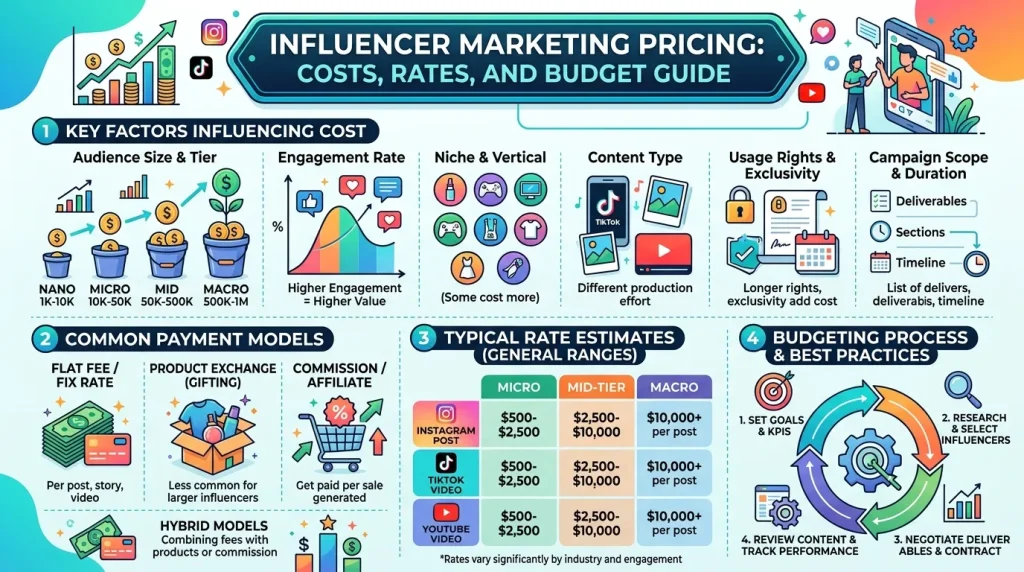
Influencer marketing pricing varies based on audience size, engagement, platform, content requirements, usage rights, and campaign scope. Understanding these factors helps brands set realistic budgets, choose the right creators, negotiate effectively, and maximize the value of influencer partnerships.
Influencer marketing pricing can vary widely depending on the creator’s audience size, engagement, niche, platform, content requirements, campaign duration, and usage rights. A small creator may charge a relatively modest amount for a sponsored post, while a well-known influencer can charge thousands or even significantly more for a campaign.
Understanding how influencer pricing works helps brands create realistic budgets and negotiate partnerships more effectively. Instead of choosing an influencer based only on follower count, businesses can evaluate the complete value of a partnership and determine whether the expected results justify the investment.
What Is Influencer Marketing Pricing?
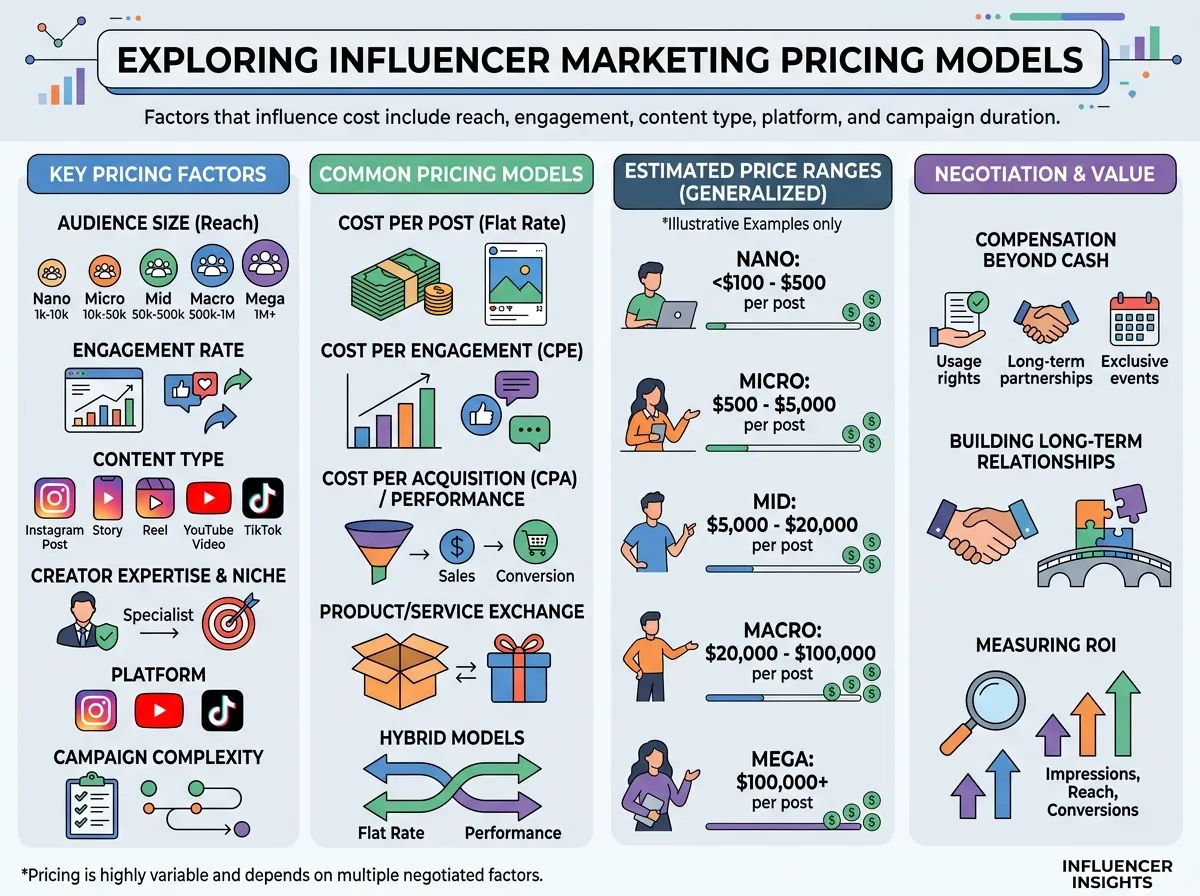
Influencer marketing pricing refers to the amount a brand pays an influencer or content creator for promotional services. These services can include sponsored posts, videos, product reviews, stories, livestreams, affiliate promotions, event appearances, or complete campaign collaborations.
There is no universal rate card that applies to every creator. Influencer marketing rates depend on several factors, and two influencers with similar follower counts may charge very different amounts.
A creator with a highly engaged niche audience may command a higher price than an influencer with a larger but less relevant audience. Content quality, professional experience, audience demographics, platform performance, and the complexity of the campaign can also affect pricing.
For this reason, brands should consider influencer marketing as an investment rather than simply a media placement.
Factors That Affect Influencer Marketing Cost
The most important factor affecting influencer marketing cost is audience size, but it is far from the only consideration. Brands should evaluate multiple factors before deciding whether a quoted price is reasonable.
Audience Size
Influencers are often categorized as nano, micro, mid-tier, macro, or celebrity creators based on their audience size. Larger audiences generally provide greater potential reach, but follower count does not automatically guarantee better campaign performance.
Smaller creators can sometimes deliver stronger engagement and more focused audiences, particularly in specialized niches.
Engagement Rate
Engagement is another important pricing factor. Comments, shares, saves, likes, views, and other interactions can indicate how actively an audience responds to the creator.
An influencer with a smaller but highly engaged audience may provide more value than a creator with millions of followers and limited interaction.
Social Media Platform
Social media influencer rates vary between platforms because content formats and audience behavior differ.
For example, short-form video content may require more production work than a simple image post. YouTube videos may require scripting, filming, editing, and longer production timelines, while Instagram Stories may involve a shorter and more flexible content process.
TikTok, Instagram, YouTube, Facebook, LinkedIn, and other platforms can therefore have different pricing structures.
Content Requirements
The amount of work required from an influencer directly affects the price. A simple sponsored mention may cost less than a professionally produced video with multiple scenes, product demonstrations, editing, captions, and revisions.
Brands should define exactly what they expect before agreeing to a price.
Understanding Different Influencer Pricing Models
Influencers can charge brands in several different ways. The right model depends on the campaign objectives, deliverables, and relationship between the brand and creator.
Some creators charge per post, while others provide package pricing for multiple pieces of content. A campaign may also involve a flat project fee, performance-based compensation, affiliate commissions, or a combination of payment methods.
A clear agreement should identify the deliverables, payment amount, deadlines, content requirements, revision limits, disclosure requirements, and usage rights.
This becomes especially important when a campaign includes several creators. Brands can learn more about building successful campaigns through an effective influencer collaboration marketing approach.
Influencer Pricing Strategy for Brands
A strong influencer pricing strategy begins with the campaign objective rather than the influencer’s quoted fee.
Suppose a brand wants to generate awareness among a specific audience. In that case, reach, audience relevance, impressions, and engagement may be important considerations. If the objective is lead generation or sales, the brand may focus more heavily on clicks, conversions, affiliate sales, or other measurable actions.
The brand should also determine how much content is needed. One sponsored post and a three-month partnership are completely different investments.
It can help to establish a maximum budget before approaching influencers. This gives marketers a clear understanding of how much they can spend while leaving room to negotiate based on campaign requirements.
Brands should also compare influencers using expected value rather than simply comparing quoted prices.
Influencer Collaboration Costs
Influencer collaboration costs can include much more than the creator’s base fee.
A campaign may involve product samples, shipping, creative production, photography, video editing, paid amplification, agency fees, affiliate commissions, event expenses, and licensing.
Usage rights can also increase the total cost. If a brand wants to reuse an influencer’s content in paid advertising, on its website, in email campaigns, or across other marketing channels, additional compensation may be required.
Exclusivity can also affect pricing. If an influencer agrees not to promote competing brands for a specific period, the creator may charge more because the agreement limits other commercial opportunities.
Before signing an agreement, brands should therefore calculate the complete campaign cost rather than focusing only on the initial influencer fee.
Influencer Campaign Pricing
Influencer campaign pricing depends on the scope and scale of the campaign.
A small campaign involving one or two creators and a few pieces of content may have a relatively simple budget. A larger campaign involving multiple influencers, different platforms, paid media, long-term contracts, and extensive content rights can become significantly more expensive.
Brands should divide campaign expenses into clear categories. These may include creator compensation, content production, product costs, paid promotion, management, and measurement.
This approach makes it easier to identify where the budget is being spent and determine which parts of the campaign are producing the strongest return.
A campaign should also have measurable objectives. If the goal is awareness, marketers can track reach and impressions. If the objective is engagement, interactions and engagement rates become important. For sales-focused campaigns, conversions and revenue provide more meaningful information.
Influencer Sponsorship Rates
Influencer sponsorship rates can differ significantly depending on the creator and campaign requirements.
A sponsored post may have a different rate from a sponsored video, livestream, product review, or long-term ambassador agreement. The platform and audience also influence the final price.
Instead of assuming there is one standard rate for each follower category, brands should request a detailed proposal. The proposal should explain what is included in the fee.
For example, brands can ask whether the quoted amount covers content creation, revisions, posting, links, product integration, exclusivity, and content usage.
This creates a clearer basis for comparing different creators.
How to Build an Influencer Marketing Budget
An effective influencer marketing budget should reflect both the campaign objective and the expected workload.
Start by determining the total amount the business is comfortable investing. Then divide the budget between creator fees and supporting expenses.
For example, a business might allocate part of its budget to influencer compensation, another portion to paid amplification, and additional funds to products, creative development, campaign management, and measurement.
The exact allocation depends on the campaign.
It is also wise to keep a small reserve for unexpected costs. Additional content requirements, shipping, revisions, or extended usage rights can increase expenses.
Businesses should avoid spending the entire budget on influencer fees without considering the other resources required to run the campaign successfully.
Influencer Partnership Pricing for Long-Term Campaigns
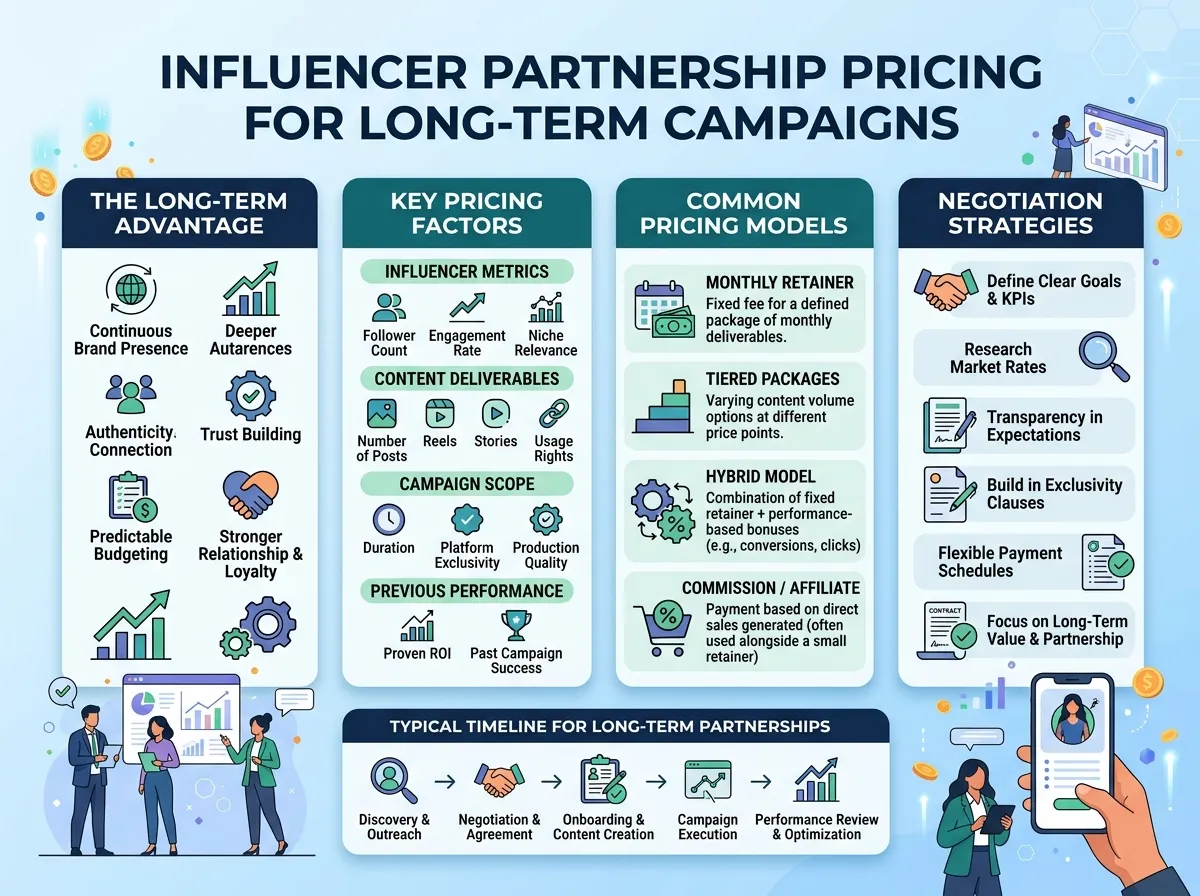
Influencer partnership pricing is particularly important when brands want to build long-term relationships with creators.
A one-time sponsored post is different from a six-month or one-year partnership. Long-term partnerships may include multiple posts, videos, product launches, events, affiliate promotions, or exclusive content.
Long-term agreements can provide benefits to both sides. Brands gain consistent access to an established audience, while influencers receive more predictable income and an opportunity to build a deeper relationship with the brand.
However, the agreement should clearly define the expected deliverables. It should also address exclusivity, content ownership, usage rights, payment schedules, performance expectations, and termination conditions.
Businesses should not assume that a long-term partnership automatically means a lower rate. The final price should reflect the total scope and value of the relationship.
For brands exploring different partnership models, it can also be helpful to compare influencer vs. brand partnerships and understand how different collaboration structures affect marketing objectives.
How to Calculate the Cost of Influencer Marketing
The cost of influencer marketing can be estimated by considering several components rather than relying on follower count alone.
A basic calculation might include:
Total Campaign Cost = Influencer Fees + Content Production + Products + Management + Paid Promotion + Usage Rights
This calculation provides a more realistic picture of the investment.
Brands should then compare the total cost with campaign results. For an awareness campaign, cost per thousand impressions may be useful. For engagement-focused campaigns, cost per engagement can provide insight. For sales campaigns, cost per acquisition and return on investment may be more important.
These metrics help businesses determine whether the campaign delivered sufficient value.
How to Negotiate Influencer Marketing Rates
Negotiation does not necessarily mean asking an influencer to reduce their price. Instead, brands can negotiate the scope of the partnership.
For example, a business with a limited budget might reduce the number of deliverables while maintaining a fair rate for the creator’s work.
Brands can also discuss package pricing when multiple pieces of content are required. Another option is combining a fixed fee with performance-based incentives.
Clear communication is essential. Influencers should know the campaign objectives, deadlines, deliverables, approval process, and usage expectations before final pricing is agreed.
Respectful negotiation can also help establish a stronger relationship, particularly when the brand hopes to work with the creator again.
How to Choose Influencers Based on Value
The cheapest influencer is not always the best choice, and the most expensive influencer is not automatically the most effective.
Brands should evaluate audience relevance, engagement quality, content style, credibility, previous partnerships, platform performance, and alignment with brand values.
For example, a B2B company may benefit more from an industry expert with a smaller professional audience than from a general lifestyle creator with a much larger following. A specialized influencer may also have stronger trust within a particular niche.
B2B brands can explore strategies for working with professional creators and industry voices through resources on B2B influencer marketing.
Creating More Value From Influencer Content
The value of an influencer campaign does not have to end when the sponsored post is published.
Brands can sometimes negotiate permission to reuse creator content across their own marketing channels. Approved content may be useful for social media, websites, email campaigns, advertisements, product pages, or other promotional activities.
However, brands should obtain appropriate usage rights rather than assuming they automatically own influencer-created content.
A strong influencer content creation strategy can help brands make better use of creator content while keeping the campaign aligned with its overall marketing objectives.
Common Influencer Marketing Pricing Mistakes
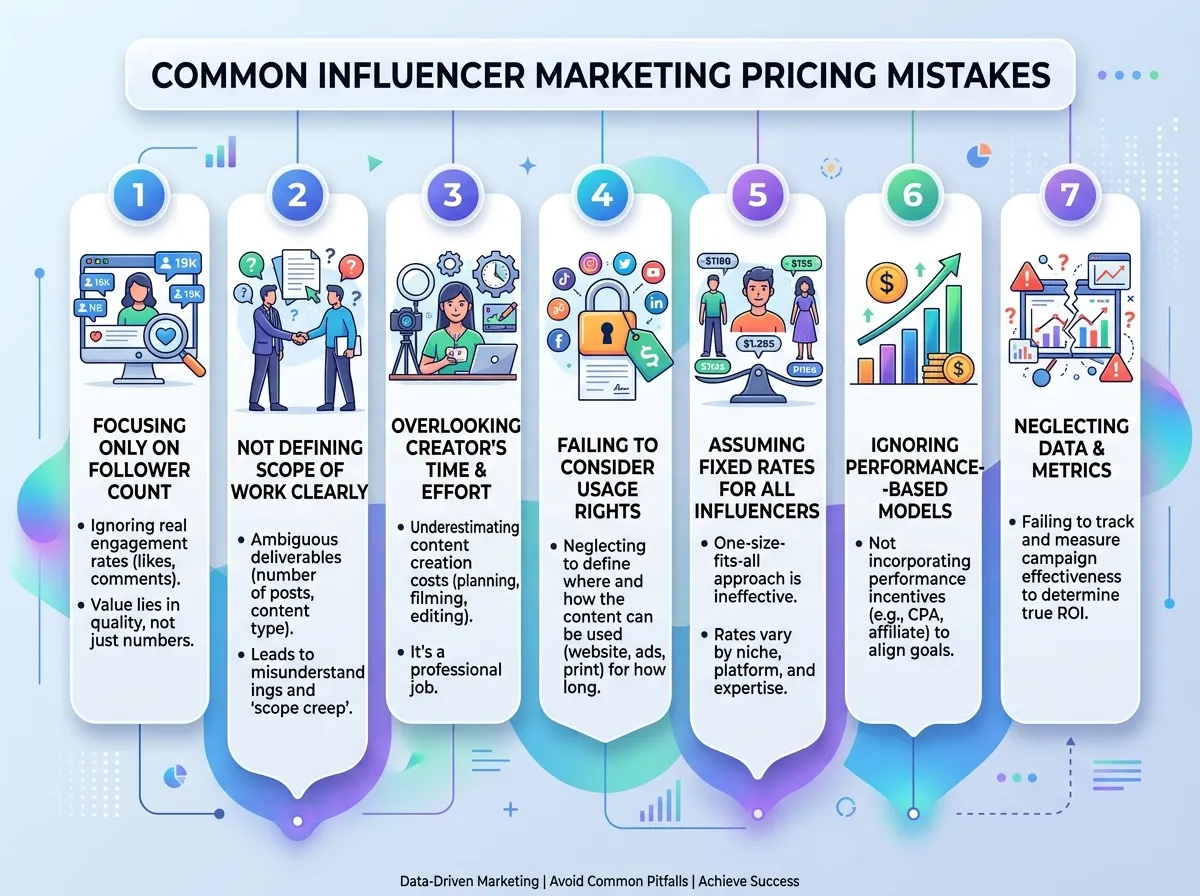
One common mistake is choosing influencers based entirely on follower count. Audience quality and relevance can be more important than raw numbers.
Another mistake is failing to define usage rights. A brand may agree to a content fee without realizing that using the content in paid advertising could require additional compensation.
Ignoring engagement quality can also lead to poor campaign decisions. Brands should examine meaningful interactions and audience relevance instead of focusing only on likes.
Businesses should also avoid unclear agreements. Campaign expectations should be documented before content production begins.
Finally, brands should measure campaign performance. Without tracking results, it becomes difficult to determine whether the investment was worthwhile.
Final Thoughts
Influencer marketing pricing depends on far more than the number of followers a creator has. Audience quality, engagement, platform, content requirements, campaign scope, usage rights, exclusivity, and partnership length can all influence the final cost.
A successful campaign starts with clear goals and a realistic influencer marketing budget. Brands should compare creators based on relevance and potential value rather than simply choosing the lowest or highest quote.
By understanding influencer marketing cost, influencer marketing rates, collaboration expenses, sponsorship rates, and partnership pricing, businesses can make more informed decisions and build campaigns that deliver measurable results.
The most effective approach is to treat influencer relationships as strategic marketing partnerships. When brands select the right creators, establish clear expectations, create useful content, and measure performance, influencer marketing can become a valuable part of a broader digital marketing strategy.
Frequently Asked Questions
1. What is influencer marketing pricing?
Influencer marketing pricing is the amount a brand pays a creator for promotional activities such as sponsored posts, videos, product reviews, stories, livestreams, or long-term partnerships.
2. How much does influencer marketing cost?
There is no single fixed cost. Influencer marketing cost depends on audience size, engagement, platform, content requirements, campaign length, usage rights, exclusivity, and the creator’s experience.
3. What factors affect influencer marketing rates?
Influencer marketing rates can be affected by follower count, engagement rate, audience relevance, platform, content format, production requirements, campaign duration, exclusivity, and content usage rights.
4. Are micro-influencers cheaper than macro-influencers?
Micro-influencers often have lower absolute fees than macro-influencers, but pricing varies widely. A micro-influencer with a highly engaged niche audience may provide significant value despite having a smaller following.
5. What are social media influencer rates based on?
Social media influencer rates are generally influenced by audience size, engagement, platform, content format, production effort, audience demographics, campaign scope, and the creator’s commercial experience.
6. How should a brand create an influencer marketing budget?
A brand should first establish its campaign goals and total available budget. It can then allocate funds across influencer fees, content production, products, campaign management, paid promotion, and usage rights.
7. What are influencer collaboration costs?
Influencer collaboration costs can include creator fees, products, shipping, content production, agency or management fees, paid promotion, exclusivity, and additional content usage rights.
8. How can brands negotiate influencer sponsorship rates?
Brands can negotiate the campaign scope, number of deliverables, content formats, partnership duration, usage rights, or package pricing rather than simply asking creators to lower their fees.
9. Is influencer marketing worth the cost?
Influencer marketing can be worthwhile when the creator has a relevant audience, strong engagement, credible content, and a clear connection to the brand’s target customers. Performance should be measured against campaign objectives.
10. Should brands choose influencers based on follower count?
No. Follower count is only one factor. Audience relevance, engagement quality, credibility, content quality, platform performance, and alignment with the brand can be more important when evaluating potential partners.