Affiliate Offer Eligibility Rules: Clear Partnership Standards

Affiliate offer eligibility rules help businesses determine who can promote an offer, which conditions affiliates must meet, and how commissions are earned. Clear requirements reduce confusion, protect brand reputation, and create a consistent process for evaluating affiliate partners. By defining qualification criteria, promotional restrictions, approval procedures, and compliance expectations, businesses can build stronger affiliate programs while giving partners a transparent path to success.
Affiliate marketing allows businesses to expand their reach through publishers, content creators, influencers, review websites, and other promotional partners. These partners introduce products or services to relevant audiences and may earn commissions when qualifying actions occur. However, not every affiliate is suitable for every offer. A partner may have strong traffic but attract the wrong audience, use promotional methods that conflict with brand policies, or operate in a market where an offer is unavailable.
Affiliate offer eligibility rules provide a structured way to address these differences. They explain which partners can participate, what conditions they must satisfy, how approval decisions are made, and which activities qualify for commissions. Instead of relying on informal judgments, businesses can use clearly documented standards to evaluate affiliates consistently.
Eligibility rules also benefit affiliates. When partners understand the requirements before promoting an offer, they can choose suitable campaigns, plan their content, and avoid preventable violations. Clear communication reduces disputes over approvals, conversions, and commission payments.
A well-designed eligibility framework should protect the business without creating unnecessary barriers for capable partners. The goal is to establish fair, relevant conditions that support the offer’s objectives, maintain compliance, and encourage long-term affiliate relationships.
Understanding Affiliate Offer Eligibility
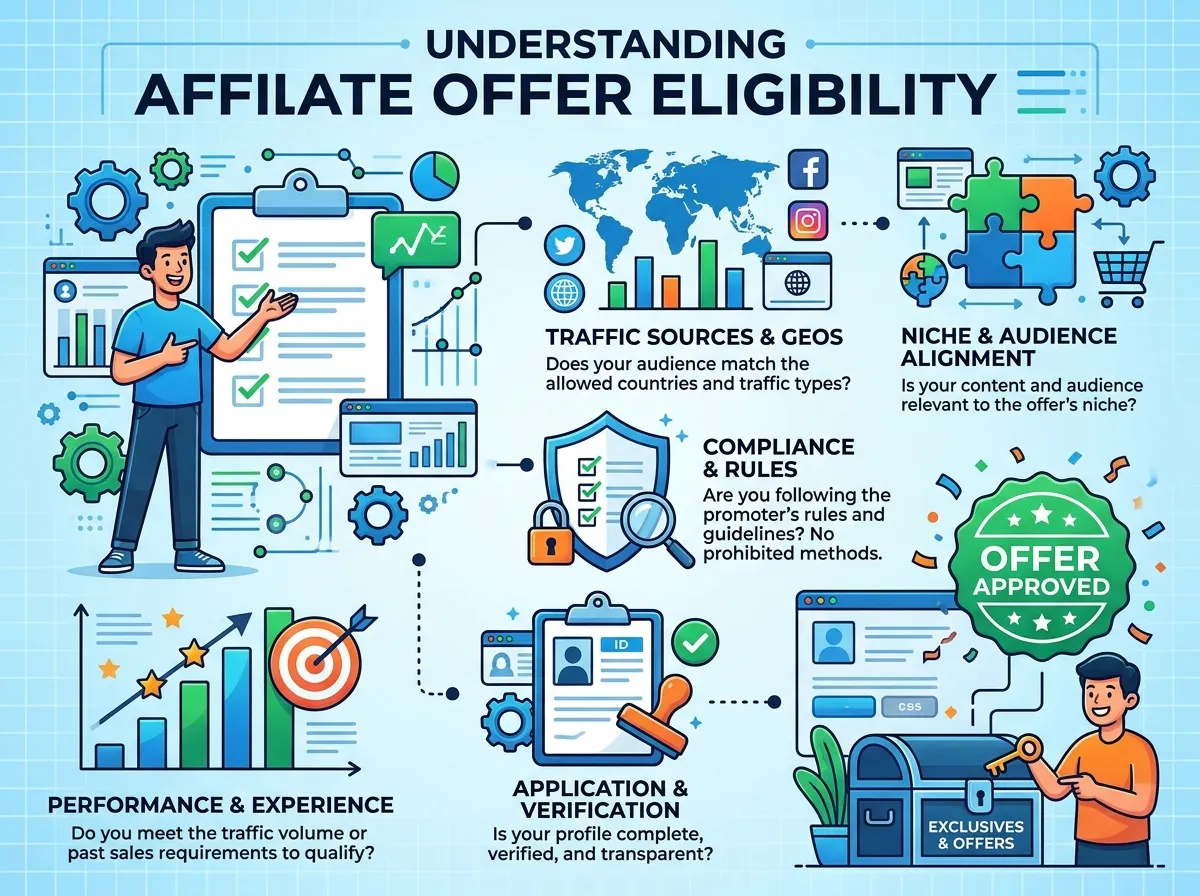
Affiliate offer eligibility refers to the conditions a publisher or partner must satisfy to access, promote, or earn commissions from a particular offer. These conditions may apply at the affiliate account level, the individual campaign level, or the conversion level.
For example, a business may accept an affiliate into its general program but require additional approval before the affiliate can promote a high-value subscription product. Another offer may be available only in selected countries or through specific traffic sources. A commission may also depend on whether a purchase is completed, a subscription remains active, or a transaction passes fraud and refund checks.
These distinctions are important because general program acceptance does not automatically mean every offer is available to every partner. Businesses should explain whether eligibility applies to the affiliate, the promotional method, the audience, the geographic market, or the resulting transaction.
A clear policy also distinguishes mandatory conditions from recommendations. A mandatory requirement determines whether an affiliate can participate or whether a conversion qualifies. A recommendation, such as publishing more detailed product reviews, may improve performance without being a formal condition of approval.
When these differences are documented, affiliates can make informed decisions before investing time and resources into a campaign. Businesses also gain a consistent reference for reviewing applications, addressing questions, and resolving disagreements.
Defining Affiliate Offer Requirements
Every offer should have a clear set of requirements that reflects its product, audience, business model, and risk level. These affiliate offer requirements establish the minimum conditions partners must meet before they can promote a specific campaign.
Requirements may cover the type of content an affiliate publishes, the relevance of its audience, the promotional channels it uses, and its ability to communicate product information accurately. A software company might prioritize technology publishers and educational content creators, while a lifestyle brand may focus on partners whose audiences are interested in its product category.
The requirements should be specific enough to guide decisions. Simply asking affiliates to be professional or have a suitable audience leaves considerable room for interpretation. More useful criteria explain the kinds of content, audience interests, promotional practices, or technical capabilities that are relevant to the offer.
Businesses should also consider the experience required for a campaign. Some offers may be suitable for new affiliates who can demonstrate an appropriate audience and responsible promotional practices. Others may require evidence of previous performance, established traffic sources, or experience communicating complex products.
Requirements should not be more restrictive than necessary. Setting an arbitrary minimum audience size, for instance, may exclude a smaller creator whose followers are highly relevant and engaged. Evaluating suitability through multiple factors can help businesses discover partners who may generate meaningful results even without a large following.
Most importantly, requirements should be communicated before affiliates begin promoting the offer. When conditions are introduced only after a partner has generated traffic or sales, the resulting confusion can damage trust and create avoidable disputes.
Establishing Affiliate Program Eligibility Criteria
While offer-specific requirements determine access to individual campaigns, affiliate program eligibility concerns whether a partner is suitable for participation in the broader program. Businesses need a consistent process for evaluating prospective affiliates and identifying potential risks.
An application review may consider the affiliate’s website, social media profiles, content quality, audience interests, traffic sources, and promotional methods. The review should also determine whether the partner’s activities align with the brand’s positioning and the program’s operating standards.
For instance, a publisher that creates useful product comparisons may be a strong fit for a consumer technology offer. A website that relies on misleading claims or copied content may be unsuitable, even if it receives considerable traffic. The same principle applies to social media creators: audience relevance and content credibility can matter more than follower count alone.
Businesses should establish a review process that can be applied consistently across applications. Reviewers need to know which criteria are mandatory, which factors require judgment, and what evidence supports a rejection or approval. Documenting decisions can help identify inconsistent practices and provide a useful record if an applicant requests clarification.
Eligibility should also be reviewed when circumstances change. A partner may shift to a new content category, introduce a different traffic source, or change its promotional methods. These changes may affect whether the affiliate remains suitable for particular offers.
A reliable program does not assume that eligibility is permanent. Instead, it provides a transparent process for initial assessment, ongoing monitoring, and reconsideration when the affiliate’s activities or the offer’s requirements change.
Creating Fair Affiliate Qualification Criteria
Strong affiliate qualification criteria help businesses distinguish between partners who are likely to represent the offer responsibly and those who may create unnecessary risk. These criteria should be relevant to actual campaign objectives rather than based on assumptions about what a successful affiliate looks like.
Audience relevance is one useful factor. A publisher with a smaller but highly interested audience may generate better-qualified prospects than a general-interest website with significantly more visitors. Businesses can examine the subjects covered by the affiliate, the questions its audience asks, and the relationship between its content and the offer.
Content credibility is another consideration. Accurate product descriptions, clear disclosures, original material, and responsible comparisons can indicate that a partner values audience trust. Businesses may also review whether the affiliate distinguishes between verified information, personal opinions, and promotional claims.
Traffic quality matters as well. Partners should be able to explain where their visitors come from and how they attract them. Unclear traffic sources, suspicious engagement patterns, or unexplained spikes may warrant additional review. However, unusual performance should be investigated rather than automatically treated as evidence of misconduct.
Technical capabilities may be relevant when offers require tracking links, approved landing pages, or particular conversion methods. The business should explain these requirements in advance and provide reasonable instructions so that qualified affiliates can meet them.
Qualification criteria should remain proportionate to the campaign. An offer with a long sales cycle may require a different evaluation approach from a low-cost retail product. By matching qualification standards to business needs, companies can protect their programs while remaining open to a diverse range of valuable partners.
Managing Affiliate Offer Restrictions

Not every promotional method, audience, or geographic market is appropriate for every offer. Affiliate offer restrictions define the activities and circumstances that are prohibited, limited, or subject to additional approval.
Restrictions may apply to paid search advertising, trademark bidding, coupon distribution, cashback promotions, email marketing, social media placements, or the use of third-party promotional networks. A business might permit content-based promotion but require separate approval for paid advertising. Another might prohibit affiliates from using brand names in certain advertising contexts to prevent confusion or protect existing marketing investments.
Geographic restrictions can also be important. A product may be available only in selected countries, or the business may be unable to fulfill orders in certain locations. Affiliates should know which markets they can target and whether language, shipping, or local advertising requirements affect eligibility.
Some offers require additional restrictions because of their product category or legal environment. Businesses should identify relevant advertising, disclosure, privacy, and consumer-protection obligations before launching an affiliate campaign. Where specialist legal advice is necessary, offer policies should be reviewed with qualified professionals.
Restrictions work best when they explain both the rule and its practical implications. If a particular traffic source is prohibited, affiliates should know whether the prohibition applies to all use of that source or only to specific activities. If coupon codes cannot be published on unauthorized deal websites, the policy should explain how approved coupon promotion works.
Unclear restrictions create inconsistent enforcement and discourage otherwise capable partners. A concise, accessible policy helps affiliates understand the boundaries and gives program managers a defensible basis for addressing violations.
Setting Affiliate Promotion Guidelines
Eligibility is not only about who can participate. It also concerns how partners are allowed to represent the offer. Affiliate promotion guidelines explain the acceptable methods for communicating product benefits, displaying links, using brand assets, and encouraging conversions.
Guidelines should help affiliates promote products accurately without removing their ability to communicate in their own voice. Businesses can supply approved descriptions, product facts, logos, images, and required disclosures while explaining which claims must not be made. This is especially important when a product involves performance claims, pricing conditions, warranties, or specific customer outcomes.
Affiliates should understand that promotional content must not mislead audiences. False scarcity, fabricated testimonials, inaccurate discounts, and unsupported promises can harm both consumers and the advertiser. Program policies should address these practices directly and explain how questionable content will be handled.
Disclosure expectations are equally important. Depending on the applicable laws and platform policies, affiliates may need to clearly disclose their financial or material relationship with the advertiser. Businesses should provide practical instructions and ensure that disclosure requirements are not buried in a lengthy policy document.
Promotion guidelines should also explain the process for obtaining approval when necessary. Certain campaigns may require advance review of advertisements, landing pages, or influencer content. Others may allow affiliates to publish independently as long as they follow established rules.
For influencer-focused campaigns, the partner’s audience is an important part of this decision. Understanding Influencer Audience characteristics can help businesses determine whether a creator’s content, communication style, and audience interests fit the offer. Audience relevance supports more meaningful promotion, while clear guidelines help protect trust between the creator, advertiser, and audience.
Designing Transparent Affiliate Approval Requirements
A clear approval process helps prospective partners understand what happens after they apply. Affiliate approval requirements should identify the information needed for review, the criteria used to evaluate applications, and whether certain offers require additional authorization.
An application may request the affiliate’s website or social profile, a description of its audience, the planned traffic sources, and the intended promotional approach. Businesses should collect only the information needed to make an informed decision and handle application details responsibly.
Once an application is received, reviewers should evaluate it against documented standards. Some decisions may be straightforward, while others require clarification. A publisher with relevant content but limited information about its traffic sources may be asked to provide further details rather than being rejected immediately.
The program should also communicate approval outcomes clearly. Approved affiliates need to know which offers they can access and whether any special conditions apply. Applicants who are declined should receive an appropriate explanation when feasible, especially if the decision is based on a specific, correctable issue.
Approval should not be confused with unrestricted access. A partner may be accepted into the program but still need separate authorization for selected offers, paid advertising, or other sensitive promotional activities. The affiliate platform and program documentation should make these distinctions visible.
Businesses should maintain records of approvals, restrictions, and important policy changes. This creates consistency between team members and makes it easier to review why a partner was granted access to a campaign.
An efficient approval process should be thorough without becoming unnecessarily slow. Clear criteria, well-designed applications, and standardized review procedures can reduce administrative work while helping qualified affiliates begin promoting offers sooner.
Explaining Affiliate Commission Eligibility
Commission rules are among the most important parts of an affiliate offer because they determine when promotional activity results in payment. Affiliate commission eligibility should explain which actions qualify, what conditions must be met, and how adjustments or reversals are handled.
A campaign may pay for completed purchases, qualified leads, subscriptions, or other defined actions. Each model needs a precise definition. If a lead-generation offer pays only for valid submissions from eligible customers, affiliates should understand what makes a submission valid and which conditions cause it to be rejected.
Businesses should also explain how cancellations, refunds, chargebacks, duplicate submissions, fraudulent activity, and other exceptions affect commissions. These conditions should be established before the campaign begins and applied consistently. Retroactively changing eligibility rules can undermine affiliate confidence and create unnecessary disputes.
Attribution is another key factor. Affiliates need to understand how referrals are tracked, which attribution rules apply, and what happens when multiple marketing channels contribute to a conversion. Tracking windows, approved links, and campaign-specific attribution conditions should be documented in accessible language.
Commission strategy should reflect the value of the action being rewarded, the economics of the offer, and the type of partner the business wants to attract. A well-considered Affiliate Commission Strategy can help align incentives with campaign goals while keeping the payment model understandable to affiliates.
Payment timing should also be explained. Businesses should identify when commissions are reviewed, whether a validation period applies, how payment thresholds work, and how partners can raise questions about missing or adjusted commissions. Where payment terms are subject to a formal agreement, offer documentation should be consistent with that agreement.
Transparent commission rules encourage affiliates to focus on qualified conversions instead of relying on assumptions about what will be paid. They also give program managers a clear standard for investigating disputed transactions.
Defining Affiliate Partner Requirements
Affiliate partner requirements help businesses set expectations for the ongoing relationship after an affiliate is accepted. These requirements can cover communication, account information, promotional conduct, policy updates, and cooperation when issues arise.
Partners should maintain accurate contact details and keep their approved websites or social profiles up to date. If they introduce a new promotional channel or materially change how they promote an offer, the program may require them to disclose that change or seek approval.
Communication expectations should be realistic. Affiliates need a reliable way to ask questions about campaign terms, tracking, creative materials, and commission decisions. Businesses should identify the appropriate support channel and explain how important program announcements will be shared.
Partner requirements can also define responsibilities during a policy review. If a business identifies an inaccurate claim or an unauthorized placement, it should have a process for notifying the affiliate, assessing the issue, and determining the appropriate corrective action. The response should reflect the severity of the issue and the terms of the program.
Ongoing management becomes easier when these expectations are part of a broader operating framework. Effective Affiliate Program Management helps businesses monitor partner activity, communicate changes, maintain consistent records, and identify opportunities to improve collaboration.
A strong partner relationship should be based on mutual clarity. Affiliates need to understand what the advertiser expects, while businesses should provide accurate offer details, timely updates, and consistent decisions. This balance encourages responsible promotion and supports partnerships that can grow over time.
Maintaining Affiliate Compliance Rules
Eligibility rules lose their value if they are not monitored and enforced consistently. Affiliate compliance rules define how businesses evaluate partner activity, respond to potential violations, and protect the integrity of the program.
Monitoring may include reviewing promotional content, checking traffic patterns, examining conversion records, and investigating complaints. The depth of monitoring should reflect the offer’s risk level and the types of promotion being used. A campaign involving sensitive claims or strict geographic restrictions may require closer oversight than a straightforward product recommendation.
Businesses should distinguish between accidental mistakes and deliberate misconduct. An affiliate who uses an outdated image or misunderstands a new requirement may need clarification and a chance to correct the issue. Deliberate deception, fabricated conversions, unauthorized data use, or repeated serious violations may require stronger action under the program’s terms.
Enforcement procedures should be documented in advance. Possible responses may include requesting corrections, temporarily restricting an offer, suspending promotional access, withholding disputed commissions where permitted by the agreement, or terminating participation for serious violations. Any financial action should follow the applicable contract, platform terms, and law.
Recordkeeping supports fair enforcement. Businesses should document the issue, relevant evidence, communication with the affiliate, and the reason for the final decision. This makes it easier to apply the same standards across partners and to resolve appeals or disputes.
Compliance also depends on effective communication. When rules change, affiliates should receive clear notice and sufficient information to understand how the changes affect their activities. Program managers should avoid relying solely on lengthy legal documents that partners may struggle to interpret.
Finally, businesses should review compliance trends. Repeated violations may indicate that an offer’s rules are unclear, onboarding is inadequate, or the approval process is attracting unsuitable partners. Using Marketing Analytics and Data-Driven Insights can help program managers examine partner performance, identify unusual patterns, and make more informed decisions about campaign quality and risk.
Reviewing and Updating Eligibility Rules

Affiliate offers change as products, markets, customer expectations, and business priorities evolve. Eligibility rules should therefore be reviewed periodically instead of remaining unchanged indefinitely.
A new product feature may alter the claims affiliates can make. Expansion into another market may introduce additional legal or operational requirements. A change in commission structure may also require revised qualification or attribution conditions. Reviewing these developments helps prevent outdated policies from creating confusion.
Businesses should gather feedback from both affiliates and internal teams. Partners may identify requirements that are difficult to interpret, while program managers may notice repeated questions or recurring violations. These signals can reveal where the policy needs clearer language or a more practical process.
Updates should be controlled and communicated properly. Organizations should identify which version of the policy applies, explain significant changes, and specify when the revised conditions take effect. Where changes affect existing partnerships or payment terms, businesses should follow contractual obligations and applicable law.
It is also useful to distinguish between core rules and campaign-specific conditions. A central affiliate policy can define universal standards for disclosure, fraud prevention, and responsible promotion. Individual offers can then specify their own geographic restrictions, traffic-source requirements, qualification thresholds, and commission conditions.
This structure makes policies easier to maintain. It avoids repeating the entire program agreement in every offer while ensuring that partners can find the requirements relevant to their campaigns.
Conclusion
Affiliate offer eligibility rules create a clear foundation for choosing suitable partners, managing promotional activity, and rewarding qualifying conversions. By defining program requirements, qualification criteria, offer restrictions, approval procedures, and commission conditions, businesses can reduce uncertainty and establish consistent expectations for every participant.
The most effective rules are specific, transparent, and proportionate to the offer. They should protect the advertiser’s reputation and commercial interests without excluding capable affiliates for reasons unrelated to campaign quality. Clear communication, consistent enforcement, and regular policy reviews help keep the framework fair as the program grows.
Businesses should treat eligibility as an ongoing process rather than a one-time approval decision. When requirements are aligned with audience needs, operational goals, and compliance obligations, affiliate partners can promote offers more confidently and program managers can make better-informed decisions. This creates a stronger environment for responsible promotion, reliable performance measurement, and sustainable affiliate relationships.
Frequently Asked Questions
1. What are affiliate offer eligibility rules?
Affiliate offer eligibility rules define the conditions partners must meet to access, promote, or earn commissions from an affiliate offer. They may cover audience suitability, traffic sources, geographic availability, approval, promotional methods, and qualifying conversions.
2. Why are eligibility rules important in affiliate marketing?
They establish consistent expectations, help prevent unsuitable promotion, reduce payment disputes, protect brand reputation, and make it easier for affiliates to understand how to participate successfully.
3. What is the difference between affiliate program eligibility and offer eligibility?
Program eligibility determines whether a partner can join the broader affiliate program. Offer eligibility determines whether that approved partner can promote a particular campaign under its specific conditions.
4. What factors should businesses consider when approving affiliates?
Businesses may evaluate audience relevance, content quality, traffic sources, promotional methods, compliance history, and the partner’s ability to represent the offer accurately. The criteria should reflect the campaign’s actual needs.
5. Can an affiliate be approved for a program but rejected for an offer?
Yes. A partner may meet the general program requirements but lack the audience, geographic reach, promotional approach, or other qualifications required for a particular offer.
6. What restrictions can apply to affiliate offers?
Restrictions may cover geographic markets, paid search, trademark bidding, coupon websites, email promotion, social media activity, product claims, and other traffic sources or promotional practices.
7. How should affiliate commission eligibility be explained?
The offer should define qualifying actions, attribution rules, validation periods, refund and cancellation conditions, disallowed conversions, payment timing, and the process for disputing commission decisions.
8. How often should affiliate eligibility rules be reviewed?
Businesses should review rules periodically and whenever products, markets, legal requirements, commission structures, or promotional practices change. Repeated affiliate questions or violations may also indicate that an update is needed.
9. What happens when an affiliate violates offer rules?
Depending on the seriousness of the violation and the program terms, the business may request corrections, restrict offer access, investigate conversions, suspend the partner, or terminate participation. Actions involving commissions should follow the applicable agreement and law.
10. How can businesses make affiliate eligibility rules easier to follow?
They can use clear language, separate general program policies from offer-specific conditions, provide examples of permitted and prohibited promotion where useful, communicate updates promptly, and offer a reliable channel for affiliate questions.