Affiliate Tiers: Structuring Rewards for Affiliate Growth

Affiliate tiers organize partners into different levels based on performance, sales, engagement, or other program requirements. A well-designed affiliate tier structure helps businesses reward productive partners, establish clear commission levels, encourage consistent promotion, and improve long-term partner relationships. By combining transparent qualification criteria, tiered commission rates, performance monitoring, and appropriate incentives, businesses can create affiliate programs that support sustainable growth while keeping rewards aligned with business objectives.
Affiliate marketing allows businesses to expand their reach by working with publishers, content creators, influencers, and other partners who promote products or services in exchange for commissions. As an affiliate program grows, however, managing every partner under the same reward structure may become less effective. Some affiliates generate consistent sales and high-quality referrals, while others are still building their audience or learning how to promote products successfully. This difference creates an opportunity for businesses to introduce affiliate tiers.
Affiliate tiers are structured levels within an affiliate program that organize partners according to defined performance standards, contribution levels, or eligibility requirements. Each tier may provide different commission rates, promotional opportunities, support, or other benefits. This approach gives businesses a way to recognize valuable partners while creating a clear path for newer affiliates to develop.
A well-planned affiliate tier structure can also improve transparency. Affiliates understand what is expected of them, how their progress is evaluated, and which benefits become available when they reach a higher level. For businesses, the structure provides a consistent framework for allocating rewards and managing partner relationships.
However, successful tiered programs require more than simply assigning different commission percentages. Businesses must choose meaningful performance criteria, establish fair qualification rules, monitor results accurately, and ensure that the additional rewards remain commercially sustainable. When these elements work together, affiliate tiers can strengthen motivation, improve partner engagement, and support long-term affiliate program growth.
Understanding Affiliate Tiers and Their Purpose
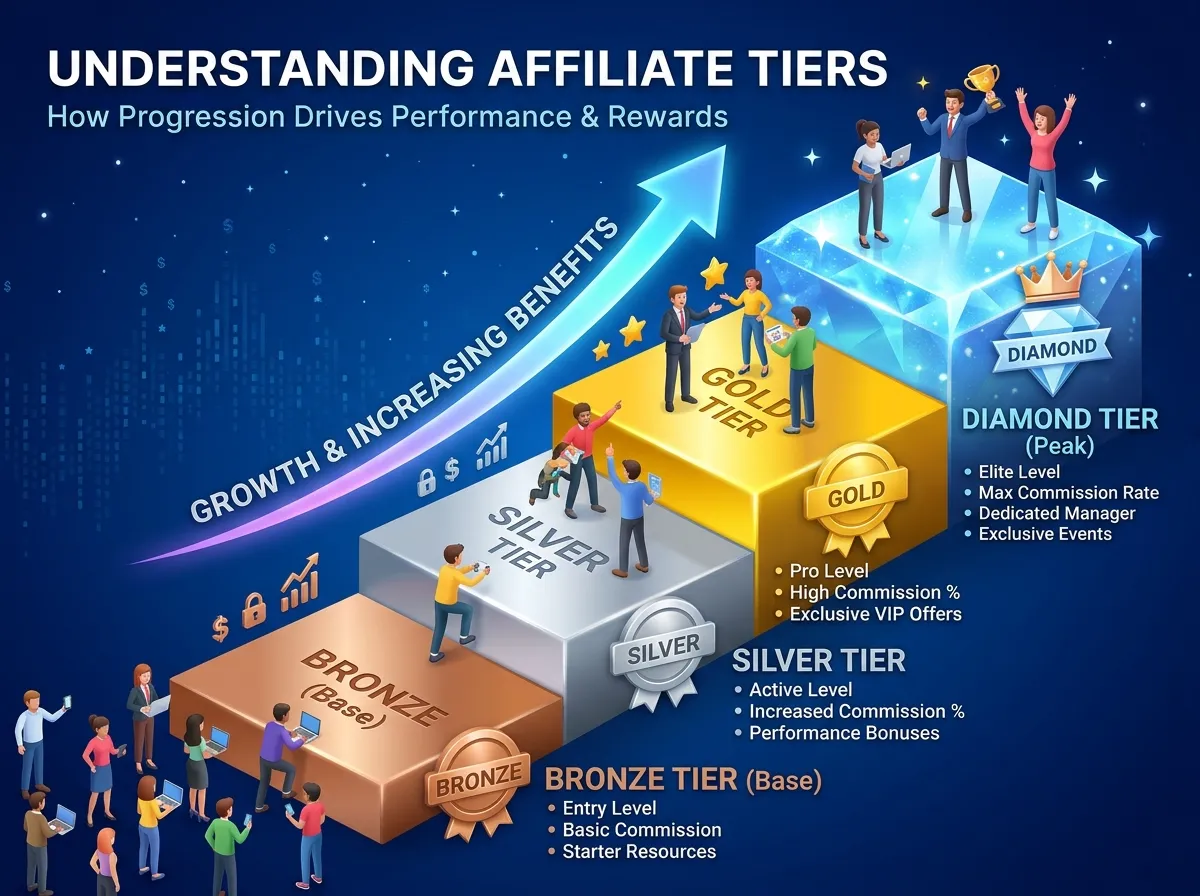
Affiliate tiers divide program participants into distinct levels that reflect their contribution to a business. Rather than treating every partner identically, companies can recognize differences in sales volume, referral quality, promotional activity, or the value generated through affiliate relationships.
For example, a business might offer an entry-level tier for newly approved affiliates, a middle tier for partners who demonstrate consistent performance, and a premium tier for affiliates who generate substantial revenue or qualified referrals. Each level can have its own requirements and benefits.
The purpose of this structure is not simply to reward the affiliates who generate the most sales. It is also to establish a system that supports development. New participants can begin with accessible requirements, learn which promotional approaches work, and progress as their results improve.
An effective tier system can also help businesses identify where different partners need support. New affiliates may benefit from promotional materials and educational resources, while established partners may value higher commissions, early product access, or closer collaboration with the brand.
Affiliate tiers are particularly useful when a program includes a large and diverse partner network. They allow businesses to manage relationships more systematically without requiring every affiliate to receive the same level of attention or incentives.
The most effective structure balances recognition with fairness. Tier membership should reflect clearly communicated requirements rather than personal preferences or unexplained decisions. This creates a more dependable relationship between the business and its affiliate partners.
Building an Effective Affiliate Tier Structure
A successful affiliate tier structure begins with a clear understanding of the program’s objectives. A company seeking greater sales volume may prioritize revenue and completed purchases, while a business focused on customer acquisition may place more importance on qualified leads, first-time customers, or conversion quality.
Once these objectives are established, the business can determine how many tiers it needs and what distinguishes each level. A simple structure with three or four levels may be sufficient for many programs. More complex programs may require additional segmentation, but excessive tiers can create confusion and increase administrative work.
Each tier should have a recognizable purpose. The entry level can help new affiliates understand the program and access essential resources. Intermediate levels can recognize consistent performance and provide stronger incentives. Higher levels can offer additional commercial benefits to partners whose contributions justify the investment.
Qualification requirements should be realistic and measurable. If the entry requirements are too demanding, new affiliates may struggle to see a path toward progression. If the requirements for higher tiers are too easy, the program may distribute premium benefits without generating sufficient additional value.
Businesses should also determine whether qualification is permanent or reviewed periodically. A lifetime tier may recognize sustained loyalty, while a quarterly or monthly review can ensure that performance-based benefits reflect recent results. Some programs combine both approaches by offering long-term partner recognition alongside periodically evaluated commission eligibility.
A clear structure makes it easier for affiliates to understand their opportunities and for program managers to explain decisions consistently.
Affiliate Commission Levels and Reward Differentiation
Affiliate commission levels are often the most visible part of a tiered program. They determine how much affiliates earn from eligible sales, leads, subscriptions, or other defined actions.
A business might provide a standard commission to all approved partners and increase the rate when affiliates meet higher performance thresholds. The higher rate may reward additional revenue, consistent customer acquisition, or a stronger contribution to the company’s growth objectives.
However, commission differences should be based on sound financial reasoning. Higher rates can encourage affiliates to invest more time in promotion, but they also reduce the amount of revenue retained by the business. Program managers must understand product margins, customer acquisition costs, refund rates, and other relevant expenses before introducing more generous rewards.
Different commission models can also suit different business needs. A company selling physical products might calculate commissions as a percentage of eligible sales. A software provider may offer recurring commissions for qualifying subscriptions, while a lead generation program may compensate affiliates for approved leads.
Regardless of the model, the rules must be clear. Affiliates should understand which transactions qualify, when commissions are calculated, how refunds affect earnings, and whether a higher rate applies to all eligible conversions or only those exceeding a particular threshold.
Reward differentiation can extend beyond commission percentages. Higher-level partners may receive dedicated account support, exclusive promotional assets, early access to products, or opportunities to participate in collaborative campaigns.
These additional benefits can make an affiliate program more attractive without relying entirely on increased payouts. The strongest commission structure rewards meaningful business outcomes while preserving the profitability of the overall program.
Tiered Affiliate Programs and Partner Development
Tiered affiliate programs create a progression system that connects partner development with business performance. Instead of viewing recruitment as the final objective, businesses can use tier progression to encourage affiliates to become more effective and consistent over time.
The experience begins when a new partner joins the program. Clear onboarding information, accessible promotional resources, and straightforward tracking tools help the affiliate understand how to get started. At this stage, the goal is to remove unnecessary barriers and establish realistic expectations.
As the affiliate begins generating referrals, the business can evaluate performance and identify opportunities for improvement. Partners who demonstrate consistent results may qualify for stronger incentives, more detailed performance insights, or additional promotional support.
Higher tiers can then recognize sustained contributions. These levels may be especially valuable for partners who consistently attract relevant audiences and generate customers who remain engaged with the business.
The program should also provide useful feedback to affiliates who have not yet qualified for advancement. If a partner is close to reaching the next level, information about the remaining requirements can make progression more understandable. However, businesses should avoid encouraging low-quality traffic or unnecessary transactions simply to help affiliates reach a threshold.
Effective partner development also depends on communication. Regular updates about program changes, new products, promotional opportunities, and performance expectations help affiliates remain informed.
By connecting progression with practical support and achievable goals, businesses can make tiered affiliate programs more engaging while encouraging partners to build stronger, more sustainable promotional practices.
Affiliate Performance Levels and Qualification Criteria
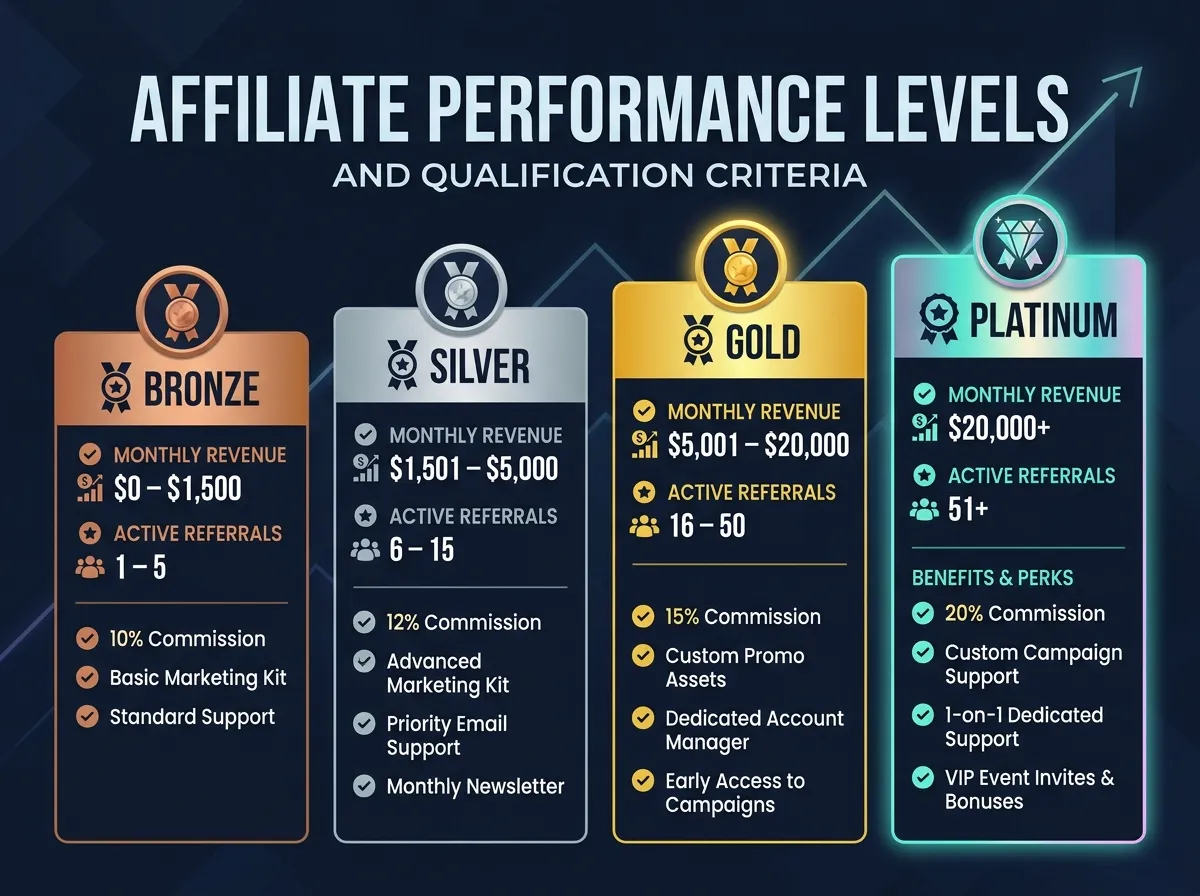
Affiliate performance levels determine how partners qualify for different benefits. These levels should reflect the objectives of the program rather than relying on a single measurement that may not capture the full value of an affiliate relationship.
Sales volume is a common qualification measure because it provides a direct indication of commercial contribution. However, revenue alone may not reveal whether an affiliate attracts suitable customers or generates transactions with healthy profit margins.
Other useful indicators include conversion rates, approved leads, new customer acquisition, repeat purchases, refund rates, and compliance with promotional requirements. The importance of each metric depends on the business model and the types of affiliates involved.
For example, a content publisher may generate fewer transactions than a high-volume coupon partner but attract customers who are more likely to remain subscribed or make repeat purchases. A program that evaluates only immediate sales could overlook the publisher’s long-term value.
Businesses should therefore select a manageable set of relevant indicators. Too many requirements can make qualification difficult to understand, while overly simple criteria may encourage affiliates to focus on activities that do not support genuine business growth.
Qualification periods also matter. Short review periods can reward recent performance, but they may disadvantage affiliates working with longer customer decision cycles. Longer periods provide a broader view of contribution but may delay recognition.
A balanced approach combines measurable targets with appropriate review periods and clear eligibility rules. This helps create performance levels that are understandable, consistent, and aligned with the business’s broader goals.
Affiliate Incentive Programs Beyond Commission Rates
Affiliate incentive programs can strengthen tier structures by recognizing achievements that are not fully reflected in standard commission payments. While higher earnings remain an important motivator, affiliates may also value recognition, access, resources, and opportunities that help them promote products more effectively.
Performance bonuses are one option. A business may reward partners for reaching a sales milestone, attracting a defined number of new customers, or achieving a specific campaign objective. These incentives work best when the requirements are transparent and the financial value of the resulting activity is understood.
Nonfinancial benefits can also support partner engagement. Premium affiliates might receive early access to new products, personalized promotional materials, invitations to partner events, or opportunities to provide feedback on upcoming campaigns.
Educational support is particularly valuable for affiliates who are still developing their promotional skills. Product information, updated creative assets, campaign announcements, and practical performance insights can help partners improve their results without requiring the business to increase commission rates immediately.
Incentives should be relevant to the affiliate’s audience and promotional methods. A content publisher may value exclusive research or access to subject-matter experts, while a creator may benefit more from product demonstrations, creative assets, or collaborative content opportunities.
The program should also avoid rewarding volume without considering quality. Incentives based entirely on raw clicks or unverified leads may encourage low-value activity. Linking rewards to approved conversions, relevant customer acquisition, and compliant promotion creates a stronger relationship between affiliate behavior and business outcomes.
When carefully designed, affiliate incentive programs can complement commission tiers and provide more flexible ways to recognize partner contributions.
Commission Tier Management and Program Transparency
Commission tier management involves maintaining accurate tier assignments, reviewing eligibility, updating commission rates, and communicating changes to affiliates. Without a consistent management process, even a well-designed structure can become difficult to administer.
Businesses need reliable records of partner activity and a clear method for calculating eligible performance. Affiliate tracking systems can help record referrals, attribute conversions, calculate commissions, and identify when partners meet established requirements.
Accurate attribution is especially important when multiple channels contribute to a customer’s purchase. A business should define how referrals are credited and explain the rules that determine whether a conversion qualifies for an affiliate commission. Clear affiliate attribution practices help reduce confusion and support fair commission calculations.
Transparency also requires communicating how tiers are reviewed. Affiliates should know when qualification periods begin and end, what happens when requirements are no longer met, and how disputed transactions are handled.
A company may choose to review performance monthly or quarterly, depending on its sales cycle and program structure. Whatever the schedule, the same rules should be applied consistently to comparable partners.
Program managers should also document changes to commission policies and provide reasonable notice whenever possible. Unexpected reductions or unexplained tier changes can damage trust, especially when affiliates have invested substantial effort in promoting a business.
Strong commission tier management protects both the company and its partners. It reduces administrative errors, improves accountability, and creates a more dependable environment for long-term collaboration.
Affiliate Program Segmentation and Partner Relationships
Affiliate program segmentation divides partners into meaningful groups based on their characteristics, promotional methods, audience, performance, or strategic value. When combined with affiliate tiers, segmentation allows businesses to create more relevant experiences for different types of partners.
A content publisher, social media creator, coupon website, comparison platform, and industry specialist may all generate affiliate referrals, but their needs and methods can differ substantially. Offering identical resources to every partner may overlook these differences.
Segmentation helps businesses adapt their communication and support. Content publishers may need detailed product information and editorial resources, while creators may benefit from creative assets and campaign collaboration. Partners focused on product comparisons may require updated specifications and clear information about pricing or availability.
Conversational affiliate marketing can provide another way to strengthen partner engagement. Timely, relevant communication helps businesses answer questions, share promotional updates, and maintain productive relationships. Resources about conversational affiliate marketing explore how communication can support more interactive marketing experiences.
Segmentation should not replace fair qualification rules. Partners with similar performance and eligibility should receive consistent treatment under the stated program policies. Instead, segmentation allows businesses to tailor support while keeping commission requirements transparent.
Businesses can also use segmentation to identify promising new affiliates, recognize established partners, and re-engage participants whose activity has declined. These insights can help program managers direct their time toward relationships that need attention.
By combining performance-based tiers with thoughtful partner segmentation, businesses can create an affiliate program that is both organized and adaptable to different promotional needs.
Measuring the Effectiveness of Affiliate Tiers

Affiliate tiers should be evaluated according to whether they improve partner performance and contribute to sustainable business growth. The existence of multiple commission levels does not automatically mean that a program is more effective.
One important measure is tier progression. If affiliates consistently advance to higher levels, the structure may be providing achievable incentives. If almost no partners progress, qualification thresholds may be unrealistic, onboarding may be inadequate, or the benefits may not be compelling enough.
Businesses should also evaluate changes in affiliate-generated revenue, conversion rates, new customer acquisition, and partner retention. Comparing results before and after introducing a tier structure can provide useful evidence, although other changes in marketing activity should also be considered.
Profitability is equally important. Increased sales do not necessarily translate into improved financial performance if higher commissions and support costs exceed the additional value generated. Program managers should examine the contribution margin after relevant affiliate expenses rather than focusing on revenue alone.
Partner feedback can reveal problems that numerical indicators may not show. Affiliates may identify confusing requirements, tracking discrepancies, unhelpful promotional resources, or benefits that do not justify the effort required to qualify.
Regular reviews allow businesses to adjust tier thresholds, improve communication, and introduce more appropriate incentives. Changes should be based on evidence and communicated clearly so that partners understand how the program is evolving.
A successful affiliate tier system is not necessarily the most complicated one. It is the structure that encourages valuable partner behavior, distributes rewards fairly, and supports profitable growth over time.
Conclusion
Affiliate tiers provide businesses with a structured way to recognize partner performance, organize commission levels, and encourage affiliates to develop stronger promotional relationships. When qualification criteria and benefits are clearly defined, affiliates gain a better understanding of their opportunities while businesses gain greater control over program management.
The strongest tiered programs combine fair performance evaluation, sustainable commission rates, useful incentives, accurate attribution, and relevant partner support. They also account for differences in affiliate audiences and promotional methods without compromising transparency.
As an affiliate program expands, regular performance reviews become essential. Businesses should evaluate not only how many partners reach higher levels but also whether the structure improves customer acquisition, partner engagement, and overall profitability.
By keeping the system understandable and aligning rewards with meaningful outcomes, businesses can build affiliate tiers that support long-term partner relationships and sustainable program growth.
Frequently Asked Questions About Affiliate Tiers
1. What are affiliate tiers?
Affiliate tiers are levels within an affiliate program that classify partners according to performance, sales, referrals, or other eligibility criteria. Each level may offer different commission rates, rewards, resources, or support.
2. How does an affiliate tier structure work?
An affiliate tier structure establishes qualification requirements for each level. Affiliates begin at an entry level and may advance by meeting defined performance targets. Higher levels can provide additional benefits in recognition of their contributions.
3. What are the benefits of tiered affiliate programs?
Tiered affiliate programs can encourage stronger performance, improve partner engagement, recognize valuable affiliates, and make reward distribution more systematic. They also give partners a clearer path for developing their relationships with a business.
4. How should businesses set affiliate commission levels?
Businesses should consider product margins, customer acquisition costs, conversion quality, industry expectations, and the value generated by each affiliate. Commission rates should motivate partners while preserving sustainable profitability.
5. Which metrics determine affiliate performance levels?
Common metrics include eligible sales, revenue, conversion rates, qualified leads, new customer acquisition, repeat purchases, and refund rates. The appropriate measurements depend on the business model and program objectives.
6. Are affiliate tiers suitable for small businesses?
Yes. Small businesses can begin with a simple structure containing a standard tier and one or two higher levels. The system can become more detailed as the affiliate network grows and management requirements increase.
7. What rewards can businesses offer beyond commissions?
Businesses can offer performance bonuses, exclusive promotional materials, early product access, personalized support, educational resources, and collaborative marketing opportunities. These benefits can complement commission increases and strengthen partner relationships.
8. How often should affiliate tiers be reviewed?
Many businesses review performance monthly or quarterly, depending on sales cycles and qualification requirements. The review schedule should be clearly communicated and applied consistently to comparable affiliates.
9. How does affiliate program segmentation relate to affiliate tiers?
Affiliate tiers organize partners according to performance or eligibility, while segmentation groups partners by characteristics such as audience, promotional method, or strategic value. Combining them allows businesses to reward performance while tailoring communication and support.
10. How can businesses measure affiliate tier effectiveness?
Businesses can track tier progression, affiliate-generated revenue, conversion rates, customer acquisition, partner retention, and profitability after commissions and related expenses. Regular reviews help determine whether the structure produces meaningful improvements.