Affiliate Commission Strategy: Build a Sustainable Affiliate Program
An affiliate commission strategy determines how businesses reward partners for generating sales, leads, referrals, or other valuable actions. A well-planned approach can help attract suitable affiliates, encourage consistent promotion, control acquisition costs, and create stronger long-term partnerships.
Affiliate programs can use different payment structures depending on the product, audience, sales cycle, profit margins, and type of partner involved. Some businesses use a fixed percentage of each sale, while others combine commissions, performance incentives, recurring payments, bonuses, or tiered rewards.
The most suitable approach depends on how the business makes money and what it expects from its affiliate partners. Rather than selecting a commission percentage in isolation, businesses can build a structure that balances partner motivation with sustainable economics.
Why an Affiliate Commission Strategy Matters
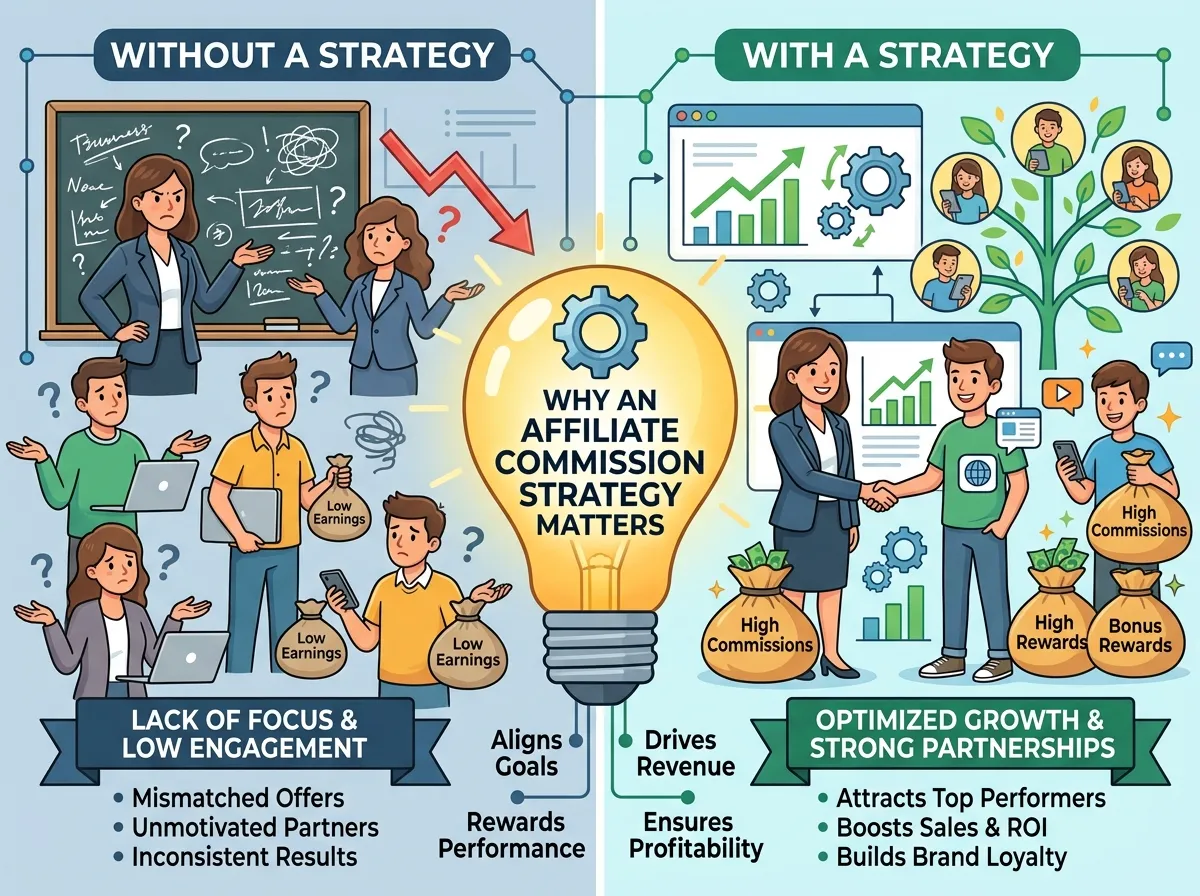
An affiliate program is based on performance. Affiliates invest their own time and resources into creating content, recommending products, building audiences, running campaigns, or sending potential customers to a business. The commission provides an incentive for those activities.
An effective affiliate commission strategy needs to be attractive enough to encourage participation while remaining financially sustainable for the business. If commissions are too low, affiliates may prioritize other programs. If commissions are too high, the business may struggle to maintain healthy margins.
The structure also influences the type of affiliates a program attracts. A program designed for content creators may work differently from one intended for coupon publishers, review websites, professional partners, or influencers.
This makes commission planning an important part of affiliate program design rather than simply an administrative payment decision.
Creating an Affiliate Commission Structure
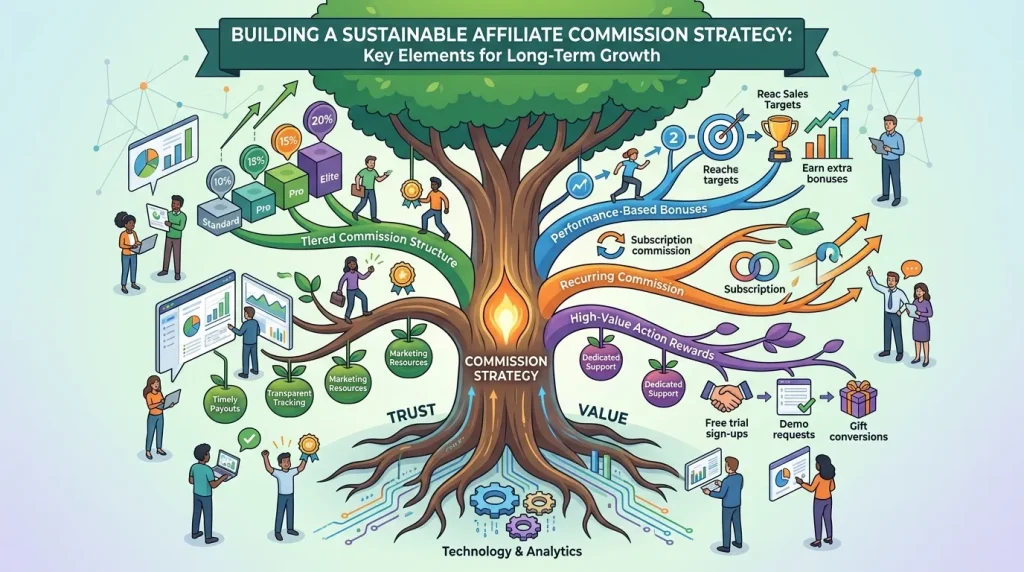
An affiliate commission structure defines how affiliates earn money and when commissions become payable. The simplest structure is a percentage of the value of an approved sale. For example, an affiliate could receive a predetermined percentage whenever a referred customer completes an eligible purchase.
Some businesses instead use fixed commissions. A partner might receive a specific amount for every qualified lead, subscription, booking, or sale. Fixed commissions can be easier to manage when the value of each conversion is relatively consistent.
Tiered structures can provide another option. Affiliates who generate higher volumes of qualified conversions may move into higher commission levels. This can encourage partners to continue growing their promotional activity while giving the business greater control over costs.
Recurring commissions can also be relevant for subscription-based products. In these programs, an affiliate may receive compensation for multiple billing cycles when the referred customer remains active, subject to the program’s terms.
Understanding Affiliate Commission Rates
Affiliate commission rates should be considered alongside product margins, average order value, customer lifetime value, refund rates, and acquisition costs. A percentage that looks attractive on its own may not be sustainable once all relevant expenses are considered.
For example, a high-margin digital product may support a different commission rate from a physical product with manufacturing, shipping, fulfillment, and customer service expenses.
Businesses should also consider the competitive environment. Affiliates often compare programs based on commission rates, cookie duration, conversion rates, product demand, payment reliability, promotional resources, and brand reputation.
A competitive commission does not necessarily mean offering the highest possible rate. Clear terms, dependable tracking, strong conversion performance, and useful promotional resources can also influence whether affiliates remain active.
Choosing an Affiliate Commission Model
An affiliate commission model should reflect the action that creates value for the business. Sales-based commissions are common for ecommerce and product-focused programs because the business pays after generating revenue.
Lead-based models can work when the primary objective is acquiring qualified prospects. In these programs, affiliates may receive a fixed amount for generating an approved lead rather than completing a purchase.
Some businesses use hybrid models that combine different rewards. An affiliate might receive a base commission for sales and additional bonuses after reaching specific performance thresholds.
Recurring models can be useful for subscription businesses where customers generate revenue over multiple billing periods. The commission structure can then reflect the longer customer relationship.
The important consideration is consistency. Affiliates should understand exactly what actions qualify for payment, how commissions are calculated, when transactions are approved, and what circumstances can result in reversals.
Building an Affiliate Payout Strategy
An affiliate payout strategy covers more than the commission percentage. It also includes payment frequency, minimum payout thresholds, payment methods, approval periods, and rules for refunds or canceled transactions.
Businesses may choose monthly payments, for example, with commissions becoming payable after a defined validation period. This can give the business time to verify transactions, account for refunds, and identify fraudulent activity.
Clear payout terms can improve affiliate confidence. Partners are more likely to invest consistently when they understand when they will be paid and how the program handles disputed or reversed commissions.
Payment methods should also reflect the geographic distribution of the affiliate network. International programs may need to support multiple payment options and consider currency conversion, tax documentation, and applicable payment requirements.
Managing an Affiliate Program Commission
An affiliate program commission should be connected to measurable business value. Businesses can evaluate whether the commission paid to affiliates produces an acceptable return after considering revenue and associated costs.
Tracking should distinguish between different affiliates, campaigns, products, and traffic sources where possible. This allows businesses to identify which partnerships generate valuable customers and which activities may require closer review.
Program terms should also clearly define attribution. Affiliates need to understand how referrals are tracked and which events qualify for commission. Clear attribution rules can reduce disagreements and make the program easier to manage as it grows.
Regular reviews can help businesses identify whether commission structures remain appropriate as products, prices, margins, and customer acquisition costs change.
Using Performance-Based Affiliate Commissions

Performance-based affiliate commissions connect compensation directly to measurable results. This model can help businesses manage marketing costs because payments are generally associated with completed qualifying actions.
Performance-based compensation can also encourage affiliates to focus on traffic quality and conversion rather than simply generating clicks. However, the definition of a qualifying conversion needs to be precise.
For example, a business may define a qualifying sale as a transaction that is completed, paid, not refunded, and outside any excluded promotional conditions. A lead-generation program may require leads to meet specific criteria before a commission becomes payable.
The more clearly these requirements are communicated, the easier it becomes for both businesses and affiliates to understand expectations.
Developing an Affiliate Incentive Strategy
An affiliate incentive strategy can complement the standard commission structure by giving partners additional reasons to increase performance.
Performance bonuses are one common approach. A business could offer an additional reward when an affiliate reaches a defined sales or lead milestone during a promotional period.
Tiered commissions can serve a similar purpose. Partners who consistently generate higher volumes may receive increased rates once they reach predefined thresholds.
Seasonal incentives can also be used around important sales periods. Businesses may temporarily increase commissions for selected products or campaigns to encourage additional promotion.
Incentives should have clear conditions and defined timeframes. A complicated incentive system can make the program difficult to understand and may reduce the usefulness of the additional rewards.
Affiliate Partner Compensation and Relationships
Affiliate partner compensation is only one part of a successful affiliate relationship. Partners may also value product quality, responsive communication, reliable tracking, marketing resources, creative assets, and timely support.
Businesses can strengthen affiliate relationships by providing updated banners, product information, promotional copy, campaign announcements, and performance insights. These resources can reduce the amount of work affiliates need to do before promoting an offer.
Businesses working with creators may also benefit from understanding broader influencer marketing practices. Resources such as How to Create an Influencer Marketing Strategy can provide additional context about planning partnerships and aligning promotional activities with broader marketing objectives.
Affiliate and influencer relationships can sometimes overlap, but the compensation model should remain clear. Influencers may receive fixed fees, affiliate commissions, free products, or combinations of these arrangements depending on the partnership.
Affiliate Marketing Commission and Different Partner Types
Affiliate marketing commission arrangements may need to vary according to partner type. A content publisher might spend significant time creating detailed reviews and comparison content, while another affiliate may specialize in email promotion or paid advertising.
The value generated by each partner can also differ based on audience quality and conversion behavior. Businesses should therefore avoid assuming that every affiliate needs exactly the same commercial arrangement.
Program rules should nevertheless remain transparent and consistent. If different commission rates are available, the eligibility requirements should be clearly explained.
Businesses should also establish rules around promotional methods. For example, they may restrict trademark bidding, misleading advertising claims, unauthorized coupon promotion, or certain forms of paid traffic.
These policies protect the brand while helping affiliates understand acceptable promotional practices.
Connecting Affiliate Marketing With Influencer Partnerships
Affiliate programs increasingly overlap with creator and influencer marketing. Influencers can use affiliate links or codes to earn commissions when their audiences purchase recommended products.
Understanding the fundamentals of creator-driven promotion can help businesses design compensation structures that fit different partnership types. How Influencer Marketing Works explains how influencer partnerships can connect audience relationships with promotional objectives.
Businesses may also develop specialized campaigns around values that matter to particular audiences. For example, brands with environmentally focused positioning may explore Green Influencer Marketing when working with creators whose audiences are interested in sustainability.
The compensation arrangement should match the partnership’s objectives. Some campaigns may combine a fixed creator fee with affiliate commission, while others may rely primarily on performance-based compensation.
Affiliate Commission Optimization
Affiliate commission optimization involves reviewing program data and adjusting compensation structures based on actual performance.
Businesses can examine metrics such as conversion rate, average order value, revenue per affiliate, commission costs, customer retention, refund rates, and customer lifetime value. These metrics can show whether the existing structure is producing sustainable results.
Optimization does not necessarily mean increasing commission rates. In some cases, better results may come from improving landing pages, providing stronger creative materials, increasing conversion rates, or helping affiliates understand which products perform best.
Businesses can also analyze affiliate performance by product and audience segment. If certain products consistently generate stronger results, the company may consider creating specific promotions or incentives around them.
Testing different commission structures can provide additional insights. A business might compare a flat commission with a tiered model or examine whether a temporary bonus improves performance during a particular campaign.
Creating a Sustainable Commission Strategy
A sustainable affiliate program balances three areas: affiliate motivation, customer value, and business profitability.
Affiliates need a reason to invest effort into promotion. Customers need relevant products and trustworthy recommendations. Businesses need enough margin to make the acquisition channel financially viable.
This balance becomes particularly important as an affiliate program grows. A structure that works for a small number of partners may need adjustment when the program begins generating significant sales volume.
Businesses should therefore review commission structures periodically rather than treating them as permanent. Changes in product pricing, margins, customer acquisition costs, competition, and affiliate behavior can all affect the appropriate structure.
Communication is equally important when changes are necessary. Affiliates should receive clear information about updated rates, effective dates, qualifying conditions, and any changes to program policies.
Measuring Affiliate Commission Performance

The effectiveness of an affiliate commission strategy should be evaluated through measurable business outcomes. Revenue alone does not provide the complete picture because commission expenses and other acquisition costs must also be considered.
Businesses can monitor the number of active affiliates, referred conversions, conversion rates, average order value, commission expense, revenue generated, refund rates, and customer retention.
Comparing these measurements over time can reveal whether the program is becoming more efficient or whether changes may be necessary.
Businesses can also identify high-performing partners and understand what makes their activity successful. This information can help shape future recruitment, promotional resources, and incentive programs.
Common Mistakes in Affiliate Commission Strategy
One common mistake is setting a commission rate without considering profitability. A rate that attracts affiliates but leaves insufficient margin can create problems as sales volume grows.
Another issue is overly complicated compensation. Affiliates should be able to understand how much they can earn and what conditions apply without navigating unnecessarily complex rules.
Poor tracking can also create difficulties. If conversions are not attributed accurately, affiliates may lose confidence in the program and businesses may struggle to evaluate performance.
Businesses should also avoid changing commission rates without adequate communication. Unexpected changes can affect affiliate planning and relationships.
Finally, commission should not be viewed as the only factor that influences affiliate performance. Product quality, website conversion rates, audience fit, promotional assets, brand reputation, and affiliate support can all affect results.
Conclusion
A well-designed affiliate commission strategy gives businesses a structured way to compensate partners while connecting affiliate activity with measurable marketing outcomes. The right approach can include percentage-based commissions, fixed payouts, recurring compensation, tiered structures, performance bonuses, or combinations of these models.
The most important consideration is alignment. Commission rates, payout rules, incentives, tracking, and partner support should work together to create a program that affiliates can understand and businesses can sustain. Businesses can also explore complementary approaches such as an Influencer Marketing Strategy to expand promotional opportunities and connect with relevant audiences.
By regularly reviewing performance data and optimizing compensation based on actual results, businesses can build affiliate programs that support long-term partnerships and measurable customer acquisition.
Frequently Asked Questions
1. What is an affiliate commission strategy?
An affiliate commission strategy is a structured approach to deciding how affiliates are compensated for generating qualifying sales, leads, subscriptions, or other valuable actions for a business.
2. How are affiliate commission rates determined?
Affiliate commission rates can depend on factors such as product margins, average order value, customer lifetime value, acquisition costs, industry conditions, and the type of affiliate involved.
3. What is a common affiliate commission structure?
A percentage of each qualifying sale is a common structure. Other approaches include fixed payments, recurring commissions, tiered rates, lead-based payments, and performance bonuses.
4. What is a performance-based affiliate commission?
Performance-based affiliate commissions reward partners according to measurable outcomes such as completed sales, qualified leads, subscriptions, or other predefined actions rather than simply paying for exposure.
5. What is an affiliate payout strategy?
An affiliate payout strategy defines when and how commissions are paid. It can include payment frequency, minimum payout thresholds, payment methods, validation periods, and rules for refunds or canceled transactions.
6. Should affiliate commission rates be the same for every partner?
Not necessarily. Businesses may use different structures based on partner type, promotional method, product category, performance level, or other clearly defined program conditions.
7. How can businesses create better affiliate incentives?
Businesses can use tiered commissions, performance bonuses, seasonal promotions, milestone rewards, and other incentives. The conditions should be transparent and connected to measurable performance.
8. How can affiliate commissions be optimized?
Affiliate commission optimization can involve reviewing conversion rates, revenue, commission expenses, customer value, refunds, and partner performance. Businesses can then adjust rates, incentives, or supporting resources based on the data.
9. What should businesses consider before increasing affiliate commissions?
Businesses should consider profitability, customer lifetime value, conversion rates, affiliate performance, competitive conditions, and the potential impact on overall acquisition costs before changing commission rates.
10. Why is transparency important in an affiliate commission strategy?
Clear commission and payout rules help affiliates understand how they earn money and reduce misunderstandings about attribution, qualifying transactions, refunds, payment timing, and promotional requirements.