B2B Affiliate Marketing: Building Partnerships That Drive Leads and Sales

B2B affiliate marketing helps businesses generate leads and sales by partnering with affiliates, publishers, consultants, and industry experts. With the right strategy, strong content, reliable tracking, and relevant partnerships, affiliate marketing can expand business reach, build trust, and create a scalable source of qualified customers.
B2B affiliate marketing is becoming an effective way for businesses to expand their reach, attract qualified prospects, and generate sales through trusted third-party partners. Instead of relying only on traditional advertising or direct sales, companies can work with affiliates who promote their products or services to relevant audiences.
The B2B buying process is often longer and more complex than consumer purchasing. Decision-makers may compare several providers, research solutions online, read expert opinions, and discuss options with colleagues before making a purchase. This makes trusted recommendations especially valuable.
A well-planned B2B affiliate marketing program can help businesses reach potential customers through partners who already have industry knowledge, professional audiences, or established communities. When the right partnerships are combined with useful content and clear performance tracking, affiliate marketing can become a valuable part of a broader growth strategy.
What Is B2B Affiliate Marketing?
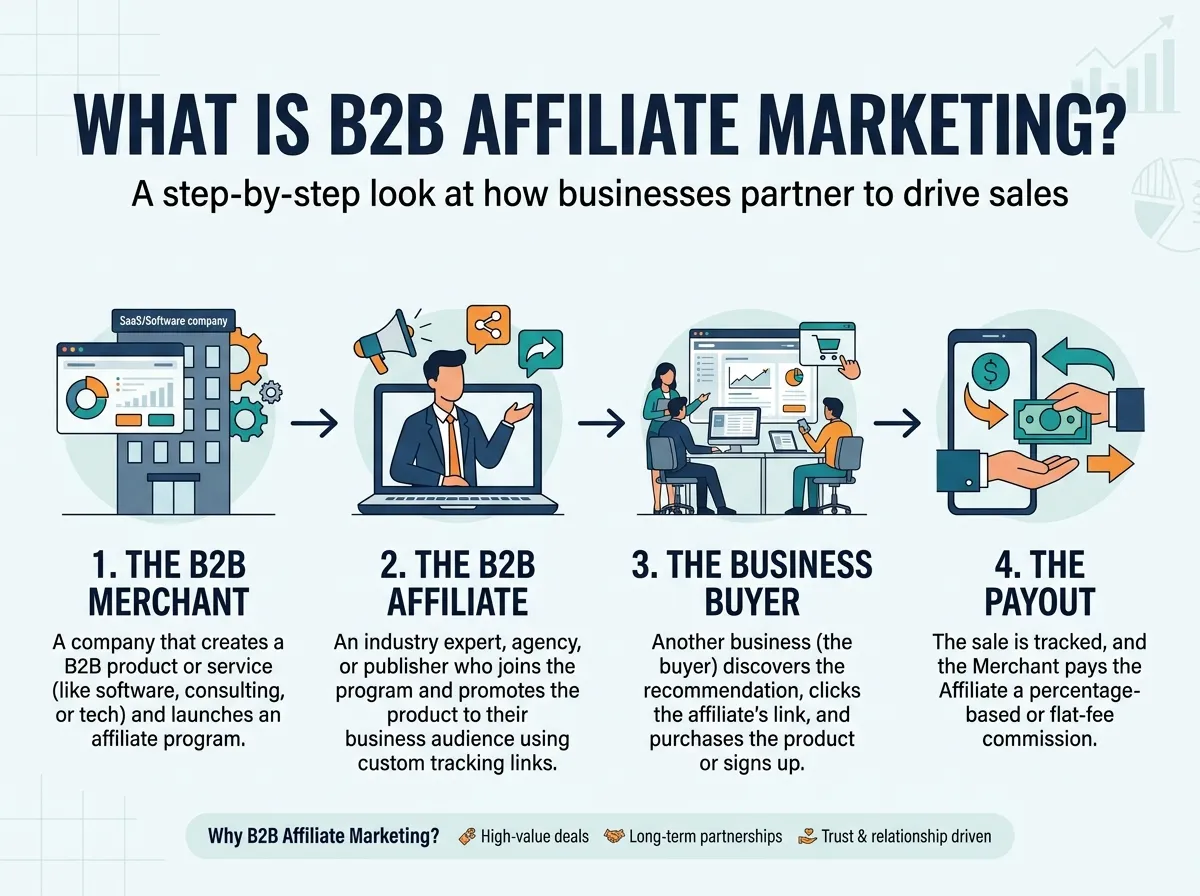
B2B affiliate marketing is a performance-based marketing approach where businesses work with individuals, publishers, consultants, content creators, industry websites, or other organizations to promote products and services.
The affiliate receives a commission or another agreed incentive when a referred visitor completes a desired action. Depending on the business model, that action could be a lead submission, consultation request, software subscription, product purchase, or another conversion.
Unlike many consumer affiliate programs, B2B programs often involve higher-value products and longer sales cycles. An affiliate might refer a potential customer today, while the actual sale may happen weeks or months later.
For this reason, successful business-to-business affiliate marketing requires strong tracking, clear agreements, quality content, and close coordination between marketing and sales teams.
Why B2B Companies Should Consider Affiliate Marketing
B2B companies often operate in competitive markets where reaching the right decision-makers can be difficult. Affiliates can provide access to audiences that a company might not reach efficiently through its own channels.
An industry publisher, consultant, or specialist website may already have an audience interested in a specific problem. When that partner recommends a relevant B2B solution, the recommendation can feel more useful and credible than a traditional advertisement.
Affiliate marketing can also create a performance-based acquisition channel. Rather than paying simply for exposure, businesses can structure programs around measurable outcomes.
This makes affiliate marketing particularly attractive for companies that want to expand their reach while keeping a close connection between marketing activity and business results.
Creating a B2B Affiliate Marketing Strategy
A strong B2B affiliate marketing strategy begins with clear goals. A business should determine what it wants its affiliate program to achieve before recruiting partners.
The goal might be increasing qualified leads, generating software subscriptions, expanding into a new market, increasing sales, or reaching a specific professional audience.
Once the objective is clear, the company can identify the types of affiliates most likely to reach its target customers. Potential partners may include industry bloggers, business consultants, review websites, publishers, educators, agencies, newsletter operators, and professional communities.
Partner quality is generally more important than partner quantity. A small group of highly relevant affiliates may generate better results than hundreds of partners with little connection to the target audience.
Choosing the Right B2B Affiliate Programs
There are many different types of B2B affiliate programs, and businesses should select a structure that matches their products, customers, and sales cycle.
Software companies may offer recurring commissions for subscriptions. Other businesses may provide one-time commissions for qualified leads or completed purchases.
Commission structure can influence affiliate motivation, but it should not be the only consideration. Affiliates also need strong promotional resources, reliable tracking, useful product information, and responsive support.
Businesses should make it easy for partners to understand what they are promoting and who the solution is designed for. Clear program rules can also reduce misunderstandings about promotional methods, brand usage, and qualified conversions.
Building Strong B2B Affiliate Marketing Partnerships
Successful B2B affiliate marketing partnerships are built around mutual value. A business needs to provide something worthwhile to its affiliates, while affiliates need to deliver relevant audiences and quality referrals.
Communication plays an important role in maintaining these relationships. Companies can provide product updates, campaign ideas, educational materials, creative assets, and performance insights.
Affiliates should also understand the brand’s positioning and customer needs. When partners have enough information to create accurate and useful content, their recommendations are more likely to resonate with potential buyers.
Relationship-focused marketing can strengthen this approach even further. Businesses interested in building long-term customer and partner relationships can also explore concepts discussed in Influencer Collaboration Marketing, where collaboration and audience trust are central to successful partnerships.
Developing Effective B2B Affiliate Marketing Campaigns
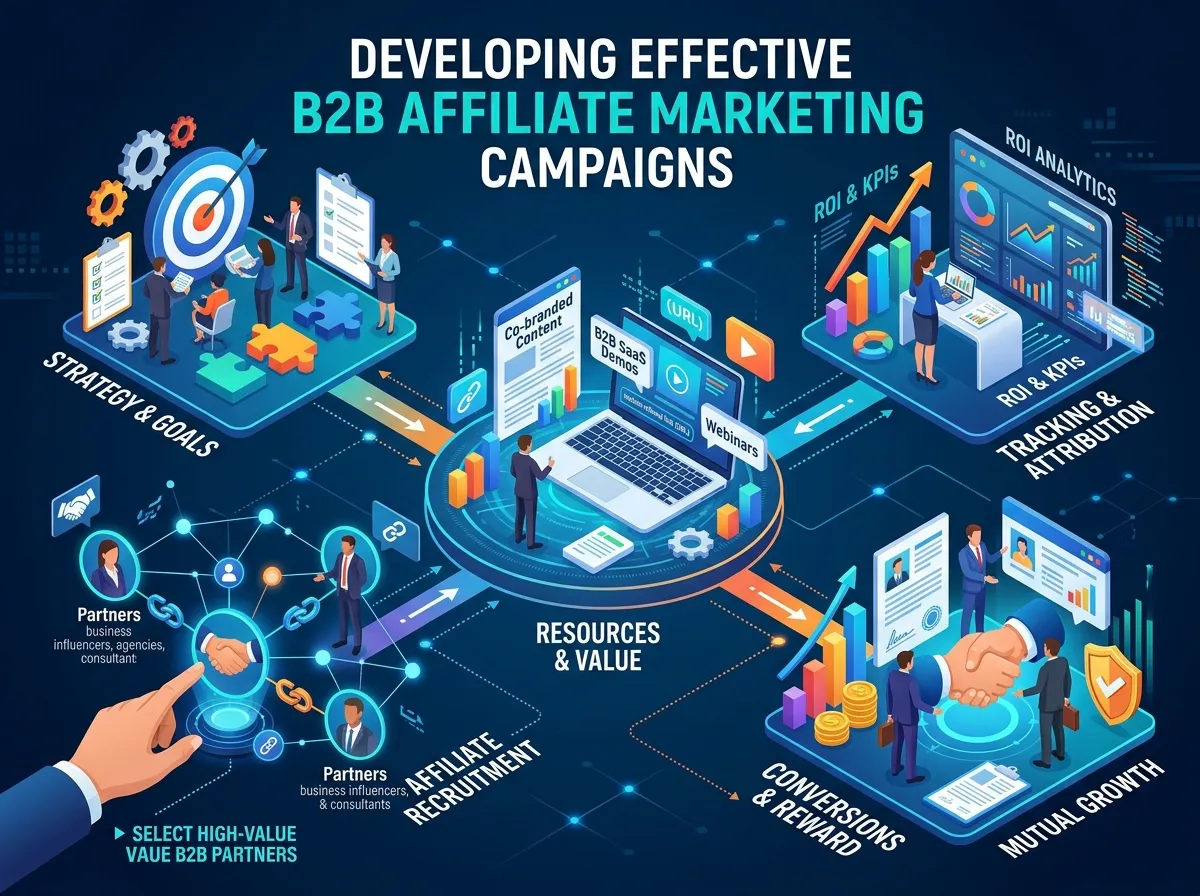
A successful affiliate program needs more than permanent links on partner websites. B2B affiliate marketing campaigns can be designed around product launches, educational resources, industry events, seasonal promotions, webinars, research reports, and special offers.
For example, a software company launching a new feature could give affiliates a detailed explanation of the feature, customer use cases, graphics, and campaign messaging. Affiliates could then create articles, videos, newsletters, or social content around the launch.
Educational campaigns can also work well for B2B audiences. Instead of immediately promoting a product, an affiliate could create content explaining a common industry challenge and introduce the company’s solution as one possible approach.
This approach keeps the content useful while still creating a path toward conversion.
Affiliate Marketing for B2B Businesses
Affiliate marketing for B2B businesses can work across many industries, including software, professional services, marketing technology, cybersecurity, education, finance, business consulting, hosting, and other specialized sectors.
The model is especially useful when a business has a clearly defined customer profile and a product that can be explained through educational content.
For example, a cybersecurity company might partner with technology publishers that review security solutions. A marketing software company could work with consultants who educate businesses about automation and lead generation.
The strongest partnerships usually exist where the affiliate’s expertise and audience naturally overlap with the company’s product.
Using Content to Support B2B Affiliate Marketing
Content plays a major role in affiliate marketing because B2B products often require explanation before customers are ready to make a decision.
Affiliates can create comparison articles, product reviews, tutorials, case studies, videos, webinars, newsletters, and industry analysis. These formats give potential customers more information and help them evaluate whether a solution fits their needs.
Businesses can support affiliates by providing accurate product documentation and useful resources. However, affiliates should also have enough flexibility to create content in their own authentic voice.
Content about influencer strategies can provide useful inspiration for businesses exploring partner-driven promotion. For example, How Influencer Marketing Works explains how trusted creators can influence audience awareness and decision-making, concepts that can also apply to certain B2B partnership models.
B2B Affiliate Lead Generation
One of the most important applications of affiliate marketing is B2B affiliate lead generation. Instead of focusing only on direct purchases, businesses can compensate partners for qualified leads.
This approach works particularly well for products or services with longer sales cycles. A potential customer may first complete a form, request a consultation, download a resource, or schedule a product demonstration before becoming a paying customer.
The business should clearly define what counts as a qualified lead. If every form submission is treated equally, affiliates may focus on quantity rather than quality.
Clear qualification criteria help align affiliate incentives with sales objectives. Businesses can also use CRM systems and tracking platforms to determine which partners generate leads that eventually become opportunities and customers.
B2B Affiliate Marketing Tactics
Several B2B affiliate marketing tactics can help improve program performance. One effective approach is creating educational resources that affiliates can reference when explaining complex products.
Another tactic is developing comparison content. Buyers often compare several solutions before making a decision, so accurate comparison pages can help affiliates address common questions.
Webinars can also create strong opportunities. An affiliate can co-host a webinar with the business, introduce the topic to its audience, and direct interested attendees toward a relevant solution.
Businesses can also develop partner-exclusive promotions, referral incentives, product demonstrations, and co-branded resources.
Event-based partnerships can provide another useful channel. Companies exploring this area can learn more from Influencer Event Marketing, particularly when partnerships are used to extend the reach and visibility of business events.
Developing a B2B Partner Marketing Strategy
Affiliate marketing can be part of a broader B2B partner marketing strategy. Instead of treating affiliates as isolated promotional channels, businesses can develop a wider ecosystem of partners.
This ecosystem may include affiliates, agencies, consultants, technology providers, resellers, industry publishers, and strategic partners.
A broader partnership strategy can create multiple opportunities for co-marketing and customer acquisition. Partners may share content, host events, create educational resources, exchange referrals, or develop joint campaigns.
The important factor is creating clear value for everyone involved. A successful partnership should benefit the business, the partner, and ultimately the customer.
Creating a B2B Affiliate Sales Strategy
A strong B2B affiliate sales strategy connects affiliate-generated leads with the company’s sales process.
Marketing and sales teams should agree on how referred leads are handled. Leads should be assigned quickly, followed up consistently, and tracked throughout the customer journey.
Attribution is particularly important for B2B businesses because a referred customer may interact with several marketing channels before purchasing.
For example, an affiliate might introduce a prospect through an educational article. The prospect may later visit the company’s website through search, subscribe to an email newsletter, attend a webinar, and eventually speak with sales.
Businesses should therefore avoid evaluating affiliates only on immediate last-click conversions. Assisted conversions and long-term customer value can also reveal the true impact of partnerships.
Measuring B2B Affiliate Marketing Performance

Tracking performance helps businesses understand which partners and campaigns produce the strongest results.
Important metrics may include affiliate clicks, conversion rates, qualified leads, customer acquisition cost, sales revenue, average order value, recurring revenue, and return on investment.
For longer B2B sales cycles, businesses should also track the quality and progression of referred leads.
An affiliate generating 20 highly qualified leads may provide more value than another affiliate generating 200 low-quality leads.
Performance data can help companies identify their strongest partners, improve campaign messaging, adjust commission structures, and invest more resources into successful channels.
Common B2B Affiliate Marketing Mistakes
One common mistake is recruiting affiliates without considering audience relevance. A large audience does not necessarily mean the partner can generate valuable B2B leads.
Another problem is providing insufficient information. Affiliates need to understand the product, target customer, benefits, limitations, and appropriate use cases.
Poor tracking can also create problems. Without reliable attribution, businesses may struggle to calculate commissions or determine which partners are actually generating customers.
Companies should also avoid overly restrictive messaging. Affiliates need clear brand guidelines, but giving them some creative freedom can make their content more authentic.
Finally, businesses should not focus only on short-term sales. B2B partnerships can produce long-term value through recurring customers, referrals, brand awareness, and new business relationships.
The Future of B2B Affiliate Marketing
B2B affiliate marketing is likely to become increasingly connected with content marketing, influencer partnerships, professional communities, and broader partner ecosystems.
As buyers continue researching products online, trusted third-party recommendations can play an important role in the decision-making process.
Businesses can also use data and automation to improve partner recruitment, attribution, communication, and performance analysis. However, technology should support relationships rather than replace them.
The most effective programs will continue to focus on relevance, trust, transparency, and measurable value.
Conclusion
B2B affiliate marketing provides businesses with a flexible way to reach new audiences, generate qualified leads, and increase sales through strategic partnerships. When supported by strong content, accurate tracking, clear incentives, and effective communication, affiliate marketing can become an important part of a B2B growth strategy.
From developing a B2B affiliate marketing strategy and finding suitable B2B affiliate programs to building partnerships and improving affiliate sales, businesses should focus on creating sustainable relationships rather than chasing short-term referrals.
The most successful programs are built around shared value. When businesses and affiliates work together to provide useful information and relevant solutions, they can create a better experience for buyers while generating meaningful growth for both sides.
Frequently Asked Questions
1. What is B2B affiliate marketing?
B2B affiliate marketing is a performance-based marketing model where businesses partner with third parties to promote products or services. Affiliates receive compensation when their referrals generate qualifying actions such as leads, subscriptions, or sales.
2. How does B2B affiliate marketing work?
A business creates an affiliate program and provides partners with tracking links or other attribution methods. Affiliates promote the business through content, websites, email, social media, or other approved channels. When a tracked referral completes a qualifying action, the affiliate receives the agreed commission.
3. Is affiliate marketing effective for B2B businesses?
Yes. Affiliate marketing can be effective for B2B companies when they work with partners who have relevant audiences and understand the products being promoted. It can be especially useful for generating qualified leads and reaching specialized professional audiences.
4. What are the best B2B affiliate programs?
The best B2B affiliate programs depend on the company’s industry, product type, sales cycle, and target audience. A strong program generally offers clear commission terms, reliable tracking, useful promotional resources, and responsive partner support.
5. How can B2B companies find affiliate partners?
Businesses can find partners through industry publishers, consultants, content creators, professional communities, agencies, review websites, newsletters, and existing business networks. The focus should be on audience relevance and partner credibility rather than simply maximizing affiliate numbers.
6. How does B2B affiliate marketing generate leads?
Affiliates can generate leads by publishing educational content, reviews, comparisons, tutorials, newsletters, webinars, and other resources that attract people interested in a particular business solution. Calls to action can then direct qualified prospects toward forms, consultations, demonstrations, or other conversion points.
7. What commission structure works best for B2B affiliate marketing?
There is no single best structure. Businesses may use one-time commissions for sales or qualified leads, while subscription-based companies may offer recurring commissions. The structure should reflect customer value, sales-cycle length, and the economics of the business.
8. What are some effective B2B affiliate marketing tactics?
Useful tactics include educational content, product comparisons, webinars, expert reviews, case studies, partner-exclusive promotions, co-branded resources, and event-based campaigns. The most effective tactic depends on the audience and product.
9. How should B2B affiliate performance be measured?
Businesses can track clicks, conversions, qualified leads, sales, revenue, acquisition costs, conversion rates, and customer lifetime value. For longer sales cycles, it is also useful to track how referred leads progress through the sales pipeline.
10. How can businesses build successful B2B affiliate partnerships?
Successful partnerships require relevant affiliates, clear expectations, reliable tracking, fair incentives, useful resources, regular communication, and mutual value. Treating affiliates as long-term partners rather than simply traffic sources can lead to stronger and more sustainable results.