Influencer Audience Overlap: Balancing Reach and Relevance

Influencer Audience Overlap measures how many followers or audience members different influencers share. By using audience analysis, demographic comparisons, and duplication measurement, brands can understand the unique reach of their creator partnerships. Evaluating these insights alongside engagement, campaign objectives, and partnership costs helps businesses reduce unnecessary duplication, improve audience reach, and build more effective influencer marketing campaigns.
Choosing influencers for a marketing campaign is not simply about finding creators with large follower counts. A creator may have hundreds of thousands of followers, but that does not necessarily mean their audience is completely different from the audiences of other influencers in the same campaign. When multiple creators reach many of the same people, brands may end up paying for repeated exposure instead of expanding their overall audience.
This is where Influencer Audience Overlap becomes an important consideration.
Influencer audience overlap refers to the number or proportion of people who follow, engage with, or are exposed to multiple influencers. Understanding this relationship helps brands determine whether their selected creators bring new audience opportunities or repeatedly reach people who already follow other campaign participants.
For example, a company working with three fitness influencers may discover that a significant portion of their followers are interested in the same workout content, nutrition products, and fitness communities. Although each influencer has an individual following, their combined audience may be considerably smaller than the total follower count suggests.
However, audience overlap is not always a disadvantage. Reaching the same person through multiple trusted creators can strengthen brand recognition and reinforce purchasing interest. The challenge is knowing when repeated exposure is useful and when it limits campaign reach.
By combining influencer audience analysis, demographic research, engagement insights, and partnership evaluation, businesses can build campaigns that balance audience expansion with meaningful repetition.
Why Influencer Audience Overlap Deserves More Attention
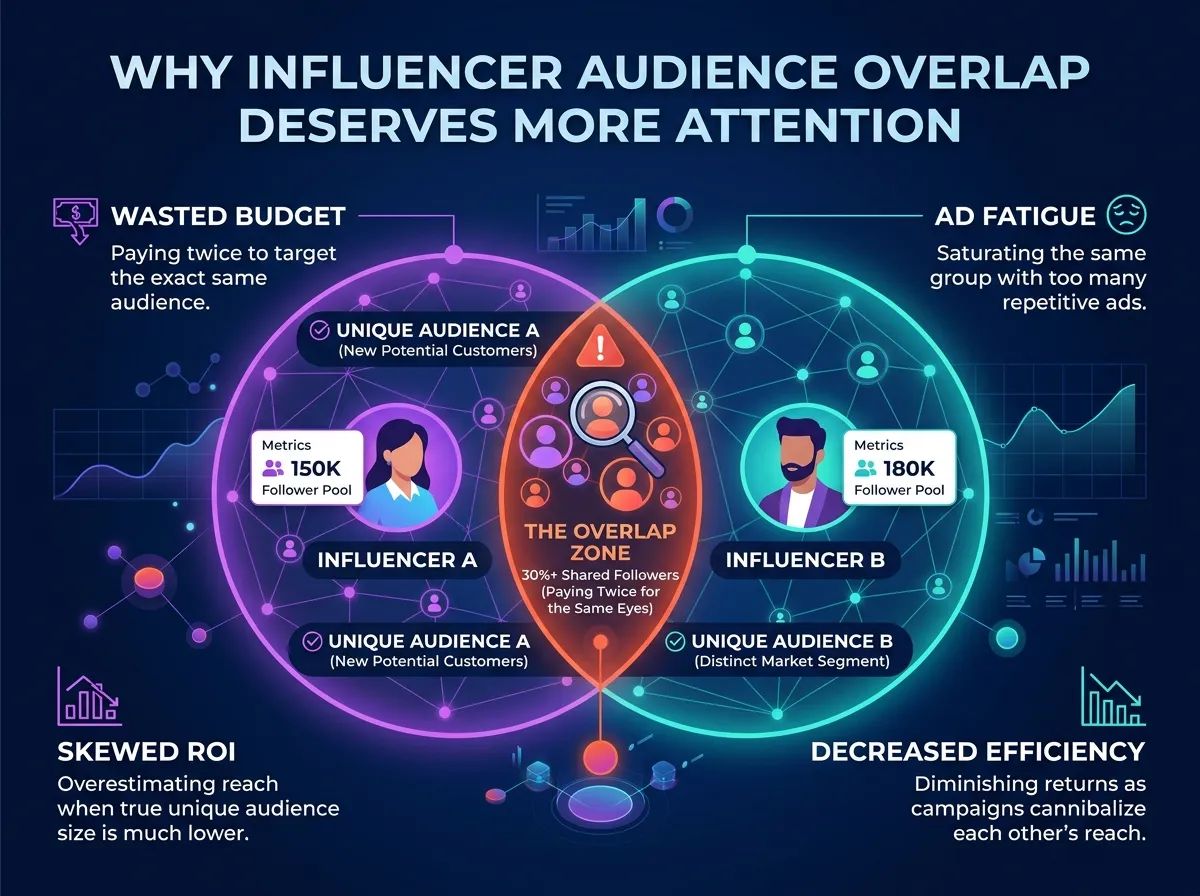
Influencer marketing campaigns often involve multiple creators because brands want to increase visibility across different communities. However, selecting influencers independently can create unexpected duplication.
Two creators may operate in different content categories while attracting similar followers. For example, a lifestyle influencer and a beauty creator may both reach young consumers interested in skincare, fashion, and personal care.
If a brand selects both creators without examining their audience characteristics, it may spend a large portion of its budget reaching the same people.
Understanding overlap provides a more realistic view of campaign potential.
Instead of adding individual follower counts together, marketers can examine how much unique audience coverage the selected influencers actually provide.
This distinction becomes particularly important when brands have limited marketing budgets or want to introduce products to new customer segments.
Audience overlap analysis also helps marketers understand the relationship between creators. Influencers who share followers may have similar audience interests, community connections, or content preferences.
These similarities can sometimes create stronger campaign consistency, especially when the brand wants repeated exposure among a specific audience.
The objective is not necessarily to eliminate overlap. It is to understand its impact and determine whether repeated exposure contributes to the campaign’s purpose.
Understanding the Difference Between Shared Followers and Actual Audience Reach
One common misunderstanding in influencer marketing is treating follower overlap as equivalent to audience reach.
Although these concepts are related, they represent different measurements.
Follower overlap identifies people who follow multiple influencers. Actual campaign reach measures the number of unique individuals who have been exposed to campaign content.
Someone may follow three influencers but only see a sponsored post from one of them. Another person may not follow any of the creators but still encounter their content through recommendations, shares, or other distribution channels.
This means follower information provides useful audience insights, but it does not automatically reveal campaign exposure.
For example, imagine a brand collaborates with two influencers:
-
Influencer A has 100,000 followers.
-
Influencer B has 80,000 followers.
-
Both creators share 30,000 followers.
Their combined unique follower audience is 150,000 rather than 180,000.
Example: Understanding audience duplication
Combined followers
180,000
Shared followers
30,000
Unique combined follower audience
150,000
Illustrative figures, not actual campaign reach.
This simple example demonstrates why brands should evaluate audience duplication before estimating the potential value of a multi-influencer campaign.
Actual reach should be assessed separately using campaign-level impression and reach data whenever available.
Influencer Audience Analysis: Looking Beyond Follower Counts
A meaningful influencer audience analysis examines who follows a creator, what interests those people have, and how they interact with the content.
Follower numbers provide an initial indication of audience size, but they reveal very little about audience quality.
Consider two influencers in the same industry. One has 250,000 followers, while the other has 90,000. At first glance, the larger creator may appear to be the better choice.
However, the smaller influencer might have stronger engagement among the exact customer segment a brand wants to reach.
Audience research can reveal differences in age groups, geographical locations, interests, language preferences, and purchasing behavior.
These characteristics help marketers understand whether creators attract genuinely different communities or compete for attention among similar groups.
Content positioning also deserves attention. Influencers who discuss related subjects may share followers even when their presentation styles are different.
For example, a travel creator who focuses on luxury destinations may overlap with a lifestyle influencer who regularly discusses premium hotels and experiences.
The two creators may offer different content formats, but their audiences could have similar interests and spending preferences.
Examining these relationships helps marketers make more informed partnership decisions.
How Audience Overlap Measurement Supports Better Campaign Decisions
Audience overlap measurement provides a way to estimate how much of an influencer’s audience is shared with another creator.
At a basic level, marketers can calculate overlap using the number of shared followers compared with the combined unique audience.
A useful measurement is the Jaccard similarity coefficient:
Here, \(A\) and \(B\) represent the follower sets of two influencers.
If two creators share 30,000 followers and have a combined unique audience of 150,000, their overlap similarity is 20%.
This calculation provides a straightforward way to compare audience duplication between creators.
However, the quality of the measurement depends on the available data. Some platforms do not provide complete follower-level information, and third-party analytics tools may rely on estimates or sampled data.
Brands should also remember that an overlap percentage does not explain whether repeated exposure is commercially valuable.
A campaign promoting a new product may benefit from reaching a particular group multiple times. Another campaign focused on market expansion may prioritize creators with more distinct audiences.
Measurement should therefore support campaign objectives rather than become an independent performance target.
Shared Audience Insights and the Value of Community Connections

Shared audience insights can reveal more than the number of people following multiple influencers.
They can help marketers understand how different creator communities relate to one another.
For example, two influencers may share a large portion of their followers because they regularly discuss similar topics. Their audiences may participate in the same online communities, follow similar brands, and respond to comparable content formats.
These connections can be valuable when a brand wants to develop a consistent message across several creators.
Repeated exposure from familiar voices may make a product or service more recognizable. It can also reinforce a message that audiences have already encountered through another creator.
However, brands should distinguish between useful repetition and unnecessary duplication.
If multiple influencers publish nearly identical promotional content to the same audience, the campaign may feel repetitive.
A better approach is to give each creator a distinct role. One influencer might introduce a product, another could demonstrate its practical benefits, and a third might share an experience-based review.
This allows brands to benefit from shared audience familiarity while offering different perspectives.
Understanding shared audience insights can therefore improve both creator selection and campaign storytelling.
Influencer Audience Comparison: Finding Complementary Creators
Influencer audience comparison helps brands determine how different creators contribute to the overall campaign.
Rather than ranking influencers only by follower count, marketers can compare their audience characteristics, content categories, geographical distribution, engagement patterns, and existing brand relationships.
Imagine a company launching a skincare product.
It considers three potential influencers:
-
A beauty creator who regularly discusses skincare routines.
-
A wellness influencer who focuses on healthy lifestyles.
-
A fashion creator whose content attracts style-conscious consumers.
These creators may share some followers, but their audiences could also contain distinct customer groups.
The beauty influencer may offer strong product relevance, the wellness creator may connect skincare with broader lifestyle interests, and the fashion creator may introduce the product to an additional audience segment.
This creates a more diversified campaign than selecting three influencers who all produce almost identical skincare content.
A useful comparison should consider the role each creator plays rather than treating all audience differences as equally important.
Brands should also examine whether the influencer’s existing content and audience expectations align naturally with the promoted product.
The strongest combination is often a group of creators who share enough relevance to support a consistent brand message while offering different audience opportunities.
Follower Demographic Analysis and Audience Quality
Demographics are an important part of understanding influencer audiences.
Two influencers may have similar follower counts but reach very different groups in terms of age, location, language, and other audience characteristics.
For businesses operating in specific markets, these differences can influence campaign performance.
A local restaurant chain, for example, may benefit more from an influencer with a smaller audience concentrated in its service area than from a large creator with followers distributed across multiple countries.
Similarly, a technology brand promoting a professional software product may prioritize creators whose audiences include business owners, marketers, or technology professionals.
Follower demographic analysis helps marketers evaluate these differences before entering partnerships.
It can also reveal whether audience overlap is concentrated within a particular demographic segment.
For instance, two influencers may share a large number of followers overall, but their audiences may differ significantly in location or age distribution.
This distinction can help brands understand whether the creators provide complementary reach despite some shared followers.
Demographic analysis should always be interpreted carefully. Audience statistics are often estimates, and broad demographic categories do not necessarily explain individual interests or purchasing intent.
Combining demographic information with engagement and content analysis provides a more complete picture.
Audience Duplication Analysis and Its Effect on Marketing Budgets
Every influencer partnership represents an investment. Brands may pay for sponsored content, campaign production, usage permissions, and additional promotional activities.
When audience duplication is high, businesses need to consider whether the additional partnership provides enough value to justify its cost.
Suppose a brand collaborates with two influencers who reach almost identical communities. The second creator may still generate value through stronger engagement, different content presentation, or greater audience trust.
However, if the campaign objective is to reach new consumers, another creator with a more distinct audience may provide a better opportunity.
This is where audience duplication analysis becomes relevant to budget planning.
Marketers can compare estimated unique audience contribution against the total cost of each partnership. They can also examine expected engagement, content quality, and historical campaign performance.
Budget decisions should not rely exclusively on the number of unique followers. A smaller but highly relevant audience may produce stronger commercial results than a larger but less interested group.
Brands planning creator investments can explore Influencer Marketing Budget to better understand how partnership costs and campaign resources fit into a broader marketing plan.
The goal is to allocate spending where it creates the strongest combination of reach, relevance, and audience response.
Influencer Reach Analysis: Understanding the Real Contribution of Each Creator
Influencer reach analysis examines how many unique people may encounter a creator’s content.
This measurement is particularly important when brands collaborate with multiple influencers because follower counts do not accurately represent actual exposure.
Reach can vary according to content format, platform algorithms, publishing frequency, audience activity, and distribution beyond existing followers.
For example, one influencer may have a relatively small following but generate strong reach through highly shareable videos. Another may have a larger audience but receive more limited distribution on individual posts.
Campaign-level reporting can provide a clearer understanding of how each partnership contributes to total exposure.
When available, marketers should compare:
-
Unique reach generated by each creator.
-
Total impressions across sponsored content.
-
Engagement from the target audience.
-
Reach contributed beyond existing followers.
-
Frequency of exposure among campaign audiences.
-
Cost relative to delivered reach.
These measurements help businesses understand whether an influencer is expanding the campaign’s visibility or mainly reinforcing exposure among existing followers.
It is also important to distinguish between reach and impressions. Reach counts unique accounts exposed to content, while impressions count total content displays, including repeated exposures.
This distinction becomes essential when evaluating campaigns with significant audience overlap.
Cross-Influencer Audience Data and Smarter Partnership Research
Managing several influencer partnerships can become complicated when brands work across different platforms and content categories.
Cross-influencer audience data helps organize information about multiple creators so marketers can identify similarities, differences, and potential partnership opportunities.
For example, a brand may compare creators based on their audience interests, geographical distribution, engagement levels, content themes, and previous collaborations.
This information can reveal unexpected connections.
A company might discover that two influencers operating in different categories share a large audience segment because both attract consumers interested in sustainable products.
Another creator may have a smaller but distinct audience that introduces the brand to an entirely new community.
Partnership research becomes more effective when these relationships are considered before campaign agreements are finalized.
It also helps brands avoid choosing creators simply because they are popular within the same industry.
A useful partnership should contribute something specific to the campaign, whether that is product credibility, audience expansion, specialist knowledge, or a different content perspective.
Businesses can further strengthen their selection process by reviewing the Influencer Marketing Partnership Guide, which explores the relationship-building side of successful creator collaborations.
Combining partnership research with audience data creates a more informed foundation for influencer selection.
Using Audience Reach Optimization to Build More Effective Campaigns
Audience reach optimization is not simply about maximizing the total number of people exposed to a campaign.
It involves balancing audience expansion, repeated exposure, relevance, and engagement.
For some campaigns, working with creators who share followers can be beneficial. A new product may require repeated visibility before consumers become familiar with it.
For other campaigns, especially those focused on entering new markets, reducing unnecessary duplication may be more important.
Brands should therefore begin with a clear understanding of their campaign objective.
If the objective is awareness among a specific consumer group, repeated exposure may support recognition. If the objective is expanding into new customer segments, creators with distinct audience characteristics may provide greater value.
Content diversity also contributes to optimization.
Different influencers can approach the same product through different experiences, demonstrations, opinions, or storytelling styles. This creates a richer campaign even when some followers overlap.
Geographical targeting can provide additional opportunities. A brand operating in multiple cities may collaborate with local creators who reach different communities.
For businesses interested in geographically focused promotion, Mastering Local Marketing provides relevant insights into reaching audiences through location-based marketing approaches.
When creator selection, content positioning, and audience research work together, brands can improve the overall value of their influencer campaigns.
Common Mistakes When Evaluating Influencer Audience Overlap
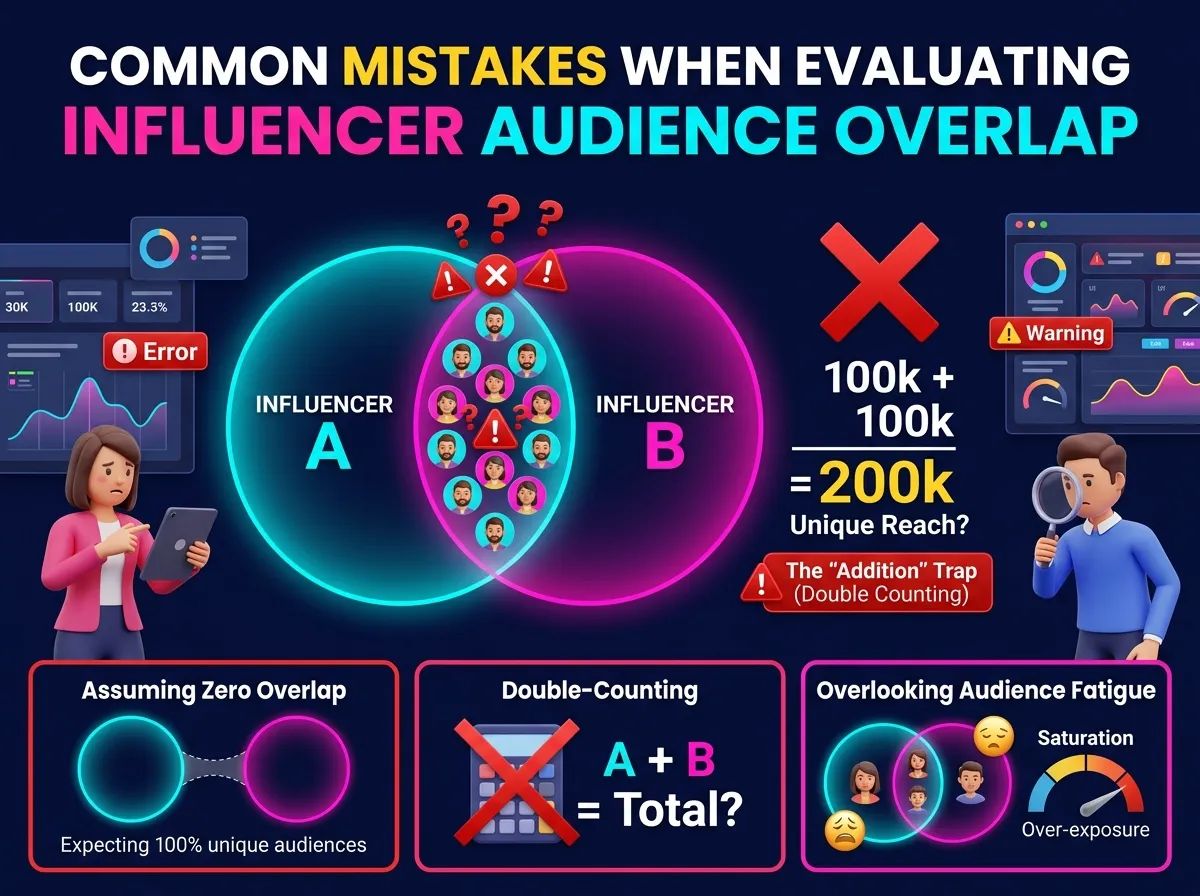
Even well-planned influencer campaigns can produce misleading results when audience data is interpreted incorrectly.
One common mistake is assuming that a high overlap percentage automatically makes an influencer unsuitable. Shared followers may still provide valuable repeated exposure, especially when creators offer different perspectives.
Another issue is relying entirely on follower counts. These numbers do not reveal actual content reach, audience quality, or purchasing interest.
Brands may also overlook platform differences. Audience overlap between creators on the same platform may be easier to estimate than overlap across different social networks, where user identities and tracking information are not always comparable.
Poor data quality creates further challenges. Some third-party tools provide estimated audience relationships rather than verified follower-level information.
Another mistake is ignoring the campaign objective. A brand focused on awareness may need a different audience combination from one focused on reaching entirely new customers.
Finally, businesses sometimes evaluate creators individually without considering how their combined audiences perform.
A stronger approach examines both individual creator value and the overall contribution of the partnership group.
Conclusion
Influencer Audience Overlap is an important factor in building effective influencer marketing campaigns. It helps brands understand how creator audiences relate to one another, identify duplicated followers, and evaluate opportunities for expanding their overall reach.
Through influencer audience analysis, demographic research, audience comparison, and partnership evaluation, businesses can make more informed decisions about which creators to include in their campaigns.
However, audience overlap should not automatically be treated as a problem. Repeated exposure can strengthen brand recognition when it reaches relevant consumers through different trusted voices.
The real objective is to understand how each influencer contributes to the campaign. By combining audience data with content quality, engagement, and marketing goals, brands can develop partnerships that deliver more meaningful reach and stronger long-term value.
Frequently Asked Questions (FAQs)
1. What is Influencer Audience Overlap?
Influencer Audience Overlap refers to the number or proportion of people who follow or engage with multiple influencers. It helps brands understand how much audience duplication exists within a campaign.
2. Why is influencer audience overlap important?
It helps businesses evaluate whether multiple influencers are reaching new people or repeatedly targeting the same audience, supporting better partnership and budget decisions.
3. How is audience overlap measured?
Audience overlap can be measured by comparing shared followers against the combined unique audience of two or more influencers. Tools may also provide estimated audience similarity.
4. Does high audience overlap always indicate a problem?
No. High overlap can create useful repeated exposure and strengthen brand recognition. It becomes a concern when duplicated reach does not support the campaign’s objectives.
5. What is influencer audience analysis?
Influencer audience analysis examines follower demographics, interests, geographical distribution, engagement patterns, and other characteristics to evaluate whether a creator is suitable for a campaign.
6. How can brands identify audience duplication?
Brands can use influencer analytics platforms, audience comparison tools, demographic reports, and available follower-overlap data to identify duplicated audience segments.
7. What is the difference between audience overlap and audience reach?
Audience overlap measures shared followers or audience members, while reach measures the number of unique people who actually see specific content.
8. How does audience overlap affect influencer marketing budgets?
High duplication may reduce the number of unique people reached by multiple partnerships. Brands can use overlap insights to compare partnership costs against their contribution to campaign objectives.
9. Can influencers with similar audiences work together successfully?
Yes. They can provide repeated exposure through different content styles, opinions, and experiences, helping reinforce brand messages among relevant audiences.
10. Which factors should brands consider when comparing influencer audiences?
Brands should examine audience demographics, interests, geographical distribution, engagement quality, estimated overlap, content relevance, and the influencer’s contribution to campaign goals.