Affiliate Marketing Cookie Tracking: Attribution and Conversions
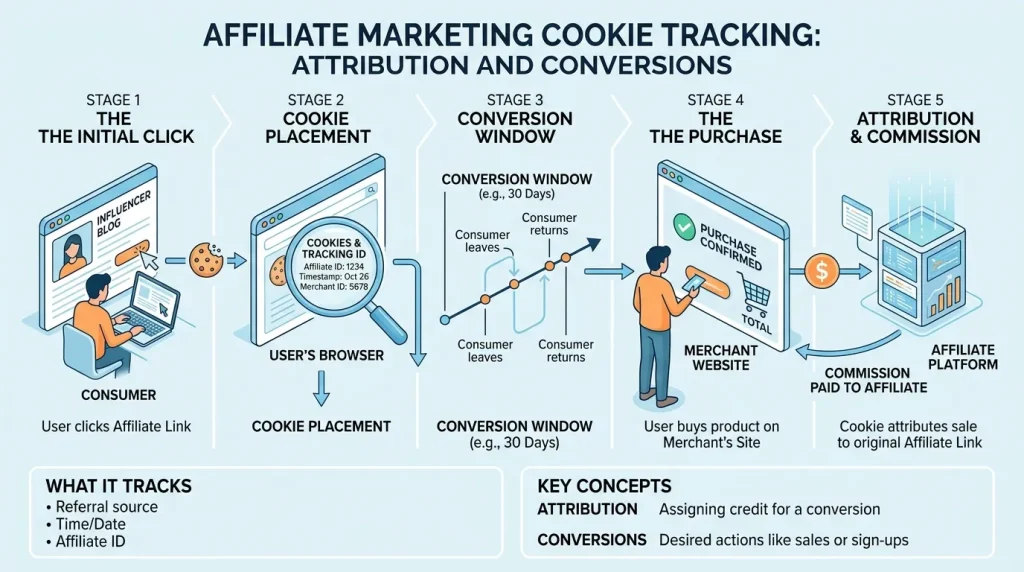
Affiliate Marketing Cookie Tracking uses browser-based identifiers to help connect affiliate referrals with later conversions. Affiliate tracking cookies can record referral information after a link click, while cookie duration influences how long that referral may remain attributable to an affiliate. Together with affiliate link tracking, conversion tracking, attribution systems, and tracking software, cookies help merchants and affiliates measure performance and manage commissions more effectively.
Affiliate marketing depends on accurate tracking. When a visitor clicks an affiliate link, completes an action, and eventually makes a purchase, the affiliate program needs a reliable way to connect that conversion to the correct publisher. Affiliate Marketing Cookie Tracking is one of the technologies traditionally used to make that connection possible.
Cookies can store information in a visitor’s browser after an affiliate link is clicked. When the visitor later completes a qualifying action, the affiliate network or merchant can use the stored information to help determine which affiliate should receive credit. This process supports commission management, conversion measurement, campaign analysis, and performance reporting.
Although affiliate tracking has become more sophisticated, cookies remain an important concept for anyone involved in affiliate marketing. Understanding how they work, how long they last, and what can affect attribution helps marketers interpret affiliate performance more accurately.
What Is Affiliate Marketing Cookie Tracking?

Affiliate Marketing Cookie Tracking refers to the use of browser cookies to identify and record affiliate referrals. When someone clicks an affiliate link, tracking information may be stored in the user’s browser. If the visitor later completes a desired action within the applicable attribution period, the affiliate program can potentially connect that conversion to the original referral.
The qualifying action could be a purchase, registration, subscription, application, or another conversion defined by the merchant or affiliate program.
The basic concept is relatively simple. An affiliate promotes a product or service and provides a special tracking link. A visitor clicks that link and is directed to the merchant’s website. Tracking information is associated with the visit, and if the visitor later converts, the system can use available attribution information to determine the referral source.
However, the actual technology behind modern affiliate tracking can be more complex than a single browser cookie. Affiliate networks and merchants may use a combination of cookies, server-side tracking, unique identifiers, pixels, redirects, APIs, first-party data, and other attribution technologies.
Understanding Affiliate Cookie Tracking
Affiliate Cookie Tracking is designed to preserve information about an affiliate referral between the initial click and a later conversion. This is important because customers do not always purchase immediately after clicking an affiliate link.
A visitor may discover a product through an affiliate article, review it, compare alternatives, leave the website, and return several days later. If the affiliate program’s attribution rules allow the original referral to receive credit, the tracking mechanism helps connect the earlier interaction with the eventual conversion.
The cookie may contain or reference information associated with the affiliate click. Depending on the tracking system, this can include an affiliate identifier, campaign information, click identifiers, or other technical data.
The information stored and the way it is processed depend on the affiliate platform, merchant, browser environment, and applicable privacy practices.
How Affiliate Tracking Cookies Work
Affiliate Tracking Cookies generally become relevant after a user clicks a tracked affiliate link. The link may contain a unique affiliate identifier or other parameters that allow the affiliate platform to recognize the referring partner.
The user is then redirected to the merchant’s website. During this process, a cookie or another tracking mechanism may be used to associate the visitor with the affiliate referral.
If the visitor completes a qualifying conversion within the applicable attribution window, the tracking system checks the available referral information. If the referral meets the program’s attribution rules, the conversion can be associated with the affiliate.
The process may happen without the customer noticing anything beyond the normal website experience. However, privacy regulations, browser restrictions, consent requirements, and technical changes can influence how tracking operates.
This is why affiliates should avoid assuming that every click will always result in a trackable conversion.
Cookie-Based Affiliate Tracking and Attribution
Cookie-Based Affiliate Tracking has historically been one of the most common methods used in affiliate programs. Its usefulness comes from its ability to maintain referral information beyond the initial click.
Consider a visitor who clicks an affiliate link on Monday but does not make a purchase until Thursday. If the program has an attribution period that covers those days and the tracking information remains available, the affiliate may receive credit for the conversion.
The exact outcome depends on the program’s terms. Some programs use first-click attribution, while others use last-click or another attribution model. Some may give priority to specific channels or promotional methods.
This means the presence of a cookie does not automatically guarantee a commission. Attribution rules determine how the available tracking information is interpreted.
Affiliate Conversion Tracking
Affiliate Conversion Tracking focuses on measuring the actions generated through affiliate referrals. A conversion could be a completed sale, lead submission, free trial registration, app installation, or another action that the affiliate program considers valuable.
Conversion tracking allows merchants to understand which affiliates are generating results. Affiliates can also use conversion data to understand which content, campaigns, traffic sources, and promotional methods are producing meaningful outcomes.
For example, an affiliate might generate thousands of clicks but relatively few conversions. Another affiliate might generate fewer visitors but produce a higher number of purchases. Conversion tracking provides the information needed to distinguish traffic volume from actual performance.
Accurate conversion tracking is therefore important for both sides of an affiliate relationship.
Affiliate Referral Tracking
Affiliate Referral Tracking focuses on identifying where a visitor or conversion originated. The affiliate referral can be associated with a particular publisher, campaign, link, channel, or promotional placement.
This information is useful because affiliate marketing often involves multiple promotional channels. A marketer might promote the same product through a website, email newsletter, social media content, video, or comparison page.
Referral tracking helps separate these activities and determine which sources are generating measurable results.
For merchants, referral tracking supports partner management and commission calculations. For affiliates, it can reveal which promotional channels deserve additional attention based on actual performance.
Understanding Affiliate Cookie Duration

Affiliate Cookie Duration refers to the length of time during which an affiliate referral may remain attributable through the cookie or associated tracking mechanism.
Cookie duration varies significantly between affiliate programs. Some programs may use short attribution windows, while others may allow referrals to remain eligible for a longer period.
For example, if an affiliate program uses a 30-day cookie period, a qualifying purchase made within that attribution window may potentially be credited to the affiliate, assuming other program rules are satisfied.
Cookie duration becomes especially relevant for products with longer purchasing cycles. Customers may research expensive products for days or weeks before completing a purchase. A longer attribution window can capture more of these delayed conversions, depending on the program’s rules and tracking technology.
However, affiliates should always review the actual terms of each program rather than assuming that a standard cookie duration applies universally.
Affiliate Attribution Tracking
Affiliate Attribution Tracking determines how credit is assigned when multiple marketing interactions occur before a conversion.
A customer might first discover a product through an affiliate website, later interact with a paid advertisement, receive an email, and eventually return through another affiliate link before purchasing. Which source receives credit depends on the merchant’s attribution model and tracking rules.
Some programs may use a last-click approach, while others may apply different attribution logic. The presence of several marketing interactions makes attribution more complicated than simply asking whether a cookie exists.
Attribution is particularly important when businesses operate multiple marketing channels. Affiliate marketing may interact with paid search, social media, email marketing, influencer marketing, organic search, and direct traffic.
Understanding these interactions helps merchants interpret affiliate performance in the correct context.
The Role of Affiliate Tracking Software
Affiliate Tracking Software provides the technology needed to manage affiliate referrals, clicks, conversions, commissions, and reporting. Depending on the platform, it may support cookie tracking alongside other tracking technologies.
For merchants operating affiliate programs, tracking software can reduce the administrative workload associated with monitoring large numbers of partners. Instead of manually reviewing individual referrals, businesses can use centralized reporting to monitor activity and conversions.
Tracking platforms may also provide affiliate dashboards where publishers can view clicks, conversions, commissions, and other performance metrics.
Automation can be particularly valuable when an affiliate program grows. A larger number of affiliates creates more tracking events, transactions, commission calculations, and reporting requirements. Technology helps organize these processes and reduce manual errors.
Automation is also increasingly important in influencer-focused affiliate campaigns. Businesses exploring this area can connect affiliate activity with broader Influencer Marketing Automation strategies to coordinate campaign workflows and performance tracking.
Affiliate Link Tracking
Affiliate Link Tracking allows merchants and networks to identify clicks generated through individual affiliate links. Each link can contain information that distinguishes one affiliate or campaign from another.
Affiliate link tracking can be particularly useful when an affiliate uses multiple promotional placements. For example, separate tracking links might be used for a blog article, email campaign, social media post, and video description.
This makes performance analysis more detailed. Instead of seeing only total affiliate clicks, marketers may be able to determine which specific placements are driving traffic.
Affiliate links also make it easier to connect promotional activity with conversions. When combined with conversion data, they provide a clearer view of the customer journey from referral to completed action.
Affiliate Commission Tracking
Affiliate Commission Tracking connects conversions with the commissions owed to affiliates. Once a qualifying transaction is attributed to an affiliate, the program can calculate the appropriate commission based on its rules.
Commission structures can vary widely. Some programs use a percentage of the sale, while others use fixed amounts for specific actions. Certain programs may also use different commission rates for different products, customer types, or performance levels.
Clear commission tracking is essential because affiliates need confidence that their referrals are being measured correctly. Merchants also need accurate records for financial reporting and partner management.
A well-designed commission system should clearly define how conversions are attributed, when commissions become payable, and what circumstances may result in adjustments or reversals.
Businesses developing affiliate programs may also benefit from considering their broader Affiliate Commission Strategy so that commission structures align with business objectives and partner relationships.
Privacy and Browser Changes Affect Affiliate Tracking
Affiliate tracking does not operate in isolation from broader changes in web privacy. Modern browsers increasingly limit certain forms of tracking, while privacy regulations may require transparency and user consent depending on the jurisdiction and type of data involved.
Cookie behavior can also differ between browsers, devices, and website configurations. A customer might click an affiliate link on a smartphone but complete the purchase later on a desktop computer. If the tracking system cannot connect those interactions, attribution may be affected.
These limitations mean affiliate marketers should understand that cookie-based tracking is not a perfect representation of every customer journey.
Modern affiliate platforms may therefore combine cookie-based methods with other technologies to improve measurement while addressing privacy and technical requirements.
Mobile Affiliate Marketing and Cookie Tracking
Mobile browsing has become an important part of affiliate marketing. Consumers frequently discover products through smartphones, mobile applications, social platforms, and mobile-optimized websites.
This creates additional tracking considerations because users may switch devices, browsers, or apps during the customer journey. Mobile environments can also use different technical mechanisms for attribution.
Businesses developing Mobile Affiliate Marketing Strategies should therefore consider how affiliate tracking behaves across mobile experiences. A tracking system that works well on desktop does not necessarily provide identical results across every mobile environment.
Mobile optimization also affects the quality of the customer experience. Slow pages, difficult navigation, broken affiliate links, or complicated checkout processes can reduce the likelihood that a referral becomes a conversion.
Affiliate Tracking and Influencer Content
Affiliate tracking is increasingly connected with influencer marketing. Influencers can promote products through social posts, videos, blogs, newsletters, and other content formats while using affiliate links or personalized tracking codes.
In this environment, accurate attribution helps brands understand which creators are generating measurable outcomes. It can also provide creators with performance data that helps them understand how their audiences respond to different products.
Content quality remains important. An affiliate link alone does not create meaningful value for an audience. Effective affiliate content generally works best when the product recommendation is supported by useful information, relevant context, and transparent communication.
A broader Influencer Content Creation Strategy can help connect creator content with audience interests while affiliate tracking provides a way to measure resulting actions.
Common Challenges With Affiliate Cookie Tracking
Affiliate Marketing Cookie Tracking can face several technical and attribution challenges. Cookie deletion is one example. If a visitor clears browser cookies before converting, the original referral information may no longer be available.
Different devices can create another challenge. A customer may click an affiliate link on one device and purchase on another. Unless the tracking system has a reliable way to connect those interactions, the conversion may not be attributed to the original affiliate.
Multiple affiliate interactions can also complicate attribution. A customer may click several affiliate links before making a purchase, and the program’s attribution rules determine which referral receives credit.
Tracking interruptions, browser restrictions, consent settings, ad blockers, and technical configuration issues can also affect measurement.
For these reasons, affiliate reports should be interpreted as measurements generated by a particular tracking system rather than as a perfect record of every customer interaction.
Why Accurate Affiliate Tracking Matters
Accurate tracking creates transparency between merchants and affiliates. Affiliates invest time and resources creating content, promoting products, building audiences, and generating referrals. They need reliable reporting to understand whether those activities are producing results.
Merchants also benefit from accurate tracking because it helps them identify productive partnerships and understand the financial impact of affiliate marketing.
When tracking is inconsistent, both sides can make incorrect decisions. Affiliates may invest more heavily in channels that appear successful because of inaccurate data, while merchants may misinterpret partner performance.
Reliable tracking therefore supports better reporting, clearer commission management, and more informed affiliate program decisions.
The Future of Affiliate Marketing Tracking

Affiliate tracking continues to evolve as browsers, privacy expectations, devices, and marketing technologies change. Cookies remain an important part of the affiliate ecosystem, but businesses increasingly need flexible tracking approaches that can work across different environments.
The future of affiliate attribution is likely to involve combinations of browser-based identifiers, first-party technologies, server-side systems, APIs, unique referral identifiers, promotional codes, and other measurement methods.
The goal remains the same: connect legitimate referrals with measurable outcomes while respecting user privacy and adapting to changing technical standards.
For affiliates and merchants, understanding the fundamentals of cookies remains valuable even as the technology becomes more sophisticated. Knowing how referral information is captured, how long attribution may last, and how conversions are assigned provides a stronger foundation for interpreting affiliate performance.
Conclusion
Affiliate Marketing Cookie Tracking plays an important role in connecting affiliate referrals with conversions and commissions. Affiliate tracking cookies can preserve referral information after a click, while cookie duration determines how long that referral may remain eligible for attribution under a program’s rules.
However, modern affiliate tracking involves more than cookies alone. Affiliate conversion tracking, referral tracking, attribution systems, affiliate link tracking, and specialized tracking software all contribute to measuring performance.
As privacy standards and browsing technology continue to evolve, merchants and affiliates need to understand both the capabilities and limitations of tracking systems. A clear understanding of attribution can lead to more transparent reporting, better partner relationships, and more reliable measurement of affiliate marketing performance.
Frequently Asked Questions
1. What is Affiliate Marketing Cookie Tracking?
Affiliate Marketing Cookie Tracking uses browser-based tracking information to help connect a visitor’s affiliate referral with a later qualifying conversion. It allows affiliate programs to identify the source of a referral and potentially assign the appropriate commission.
2. How do affiliate tracking cookies work?
When a visitor clicks an affiliate link, the tracking system can associate the visit with an affiliate identifier. A cookie or another tracking mechanism may preserve that referral information so that a later qualifying conversion can potentially be attributed to the affiliate.
3. What is affiliate cookie duration?
Affiliate cookie duration is the period during which an affiliate referral may remain eligible for attribution after a tracked interaction. The duration varies between affiliate programs and should be checked in the specific program’s terms.
4. Can affiliate cookies guarantee a commission?
No. A cookie does not automatically guarantee a commission. The conversion must meet the affiliate program’s attribution and eligibility requirements, and technical or privacy-related factors can also affect whether the referral is successfully recorded.
5. What is affiliate conversion tracking?
Affiliate conversion tracking measures qualifying actions generated through affiliate referrals. These actions may include purchases, registrations, leads, subscriptions, or other conversions defined by the merchant.
6. What is the difference between affiliate tracking and affiliate attribution?
Affiliate tracking involves collecting information about clicks, referrals, conversions, and other interactions. Affiliate attribution involves determining which referral or marketing source should receive credit for a conversion according to the program’s rules.
7. Why is affiliate link tracking important?
Affiliate link tracking helps identify where affiliate traffic originates and can distinguish between different affiliates, campaigns, content pieces, and promotional placements. It provides useful information for analyzing affiliate performance.
8. What does affiliate tracking software do?
Affiliate tracking software can manage affiliate links, clicks, conversions, referrals, commissions, and performance reports. More advanced platforms may combine several tracking technologies to support attribution across different environments.
9. Do browsers affect affiliate cookie tracking?
Yes. Browser privacy settings, cookie restrictions, tracking prevention technologies, and user choices can affect whether affiliate referral information remains available. This means cookie-based tracking may not capture every customer journey perfectly.
10. Is cookie tracking still important for affiliate marketing?
Yes, cookies remain an important concept in affiliate marketing, although modern tracking increasingly uses multiple technologies. Understanding cookies, attribution windows, referral tracking, and conversion measurement remains useful for both affiliates and merchants.