Influencer Audience Overlap: Understanding Shared Reach and Campaign Value
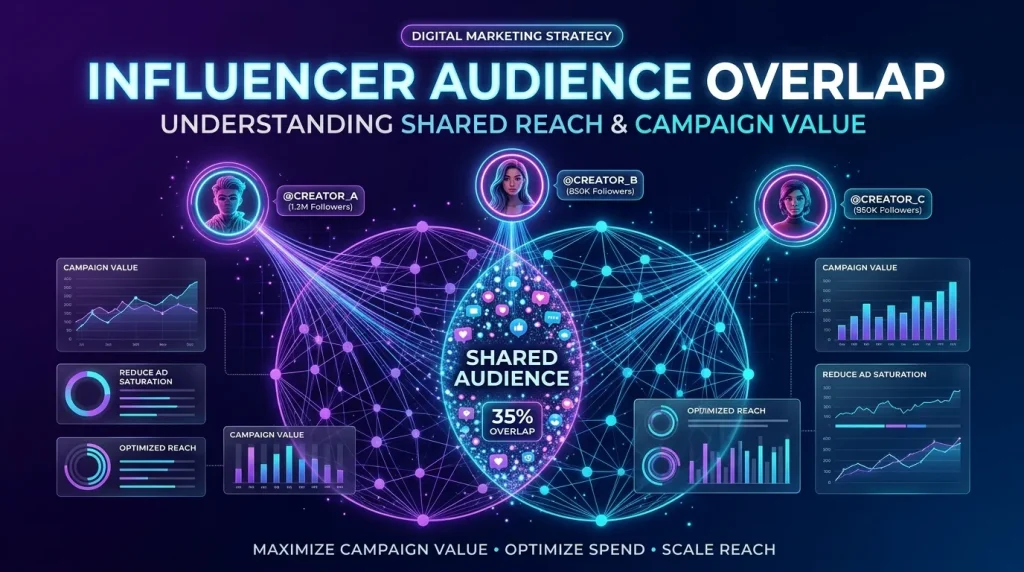
Influencer Audience Overlap helps brands understand how much their influencer partners share the same followers and audience characteristics. By analyzing shared reach, demographics, audience similarity, and campaign duplication, marketers can select complementary creators, improve campaign efficiency, and balance repeated exposure with access to new audiences.
A brand working with several influencers may expect each creator to introduce its products to a different group of potential customers. Yet when campaign reports arrive, the combined reach can look surprisingly smaller than anticipated. One influencer may have thousands of followers who also follow another creator in the same niche. A third may attract an audience with similar interests, purchasing habits, and online behavior.
This is where Influencer Audience Overlap becomes an important consideration in influencer marketing.
Audience overlap describes the extent to which two or more influencers reach the same people. It can affect campaign reach, audience diversity, engagement, and the way marketing budgets are distributed. However, overlap is not automatically a problem. Shared audiences can strengthen brand familiarity, while excessive duplication may limit the number of new people a campaign reaches.
Understanding this balance helps brands evaluate creator partnerships more intelligently. Instead of selecting influencers based only on follower counts, marketers can examine how their audiences relate to one another and determine whether a group of creators offers meaningful combined value.
Why Two Influencers Can Reach the Same People
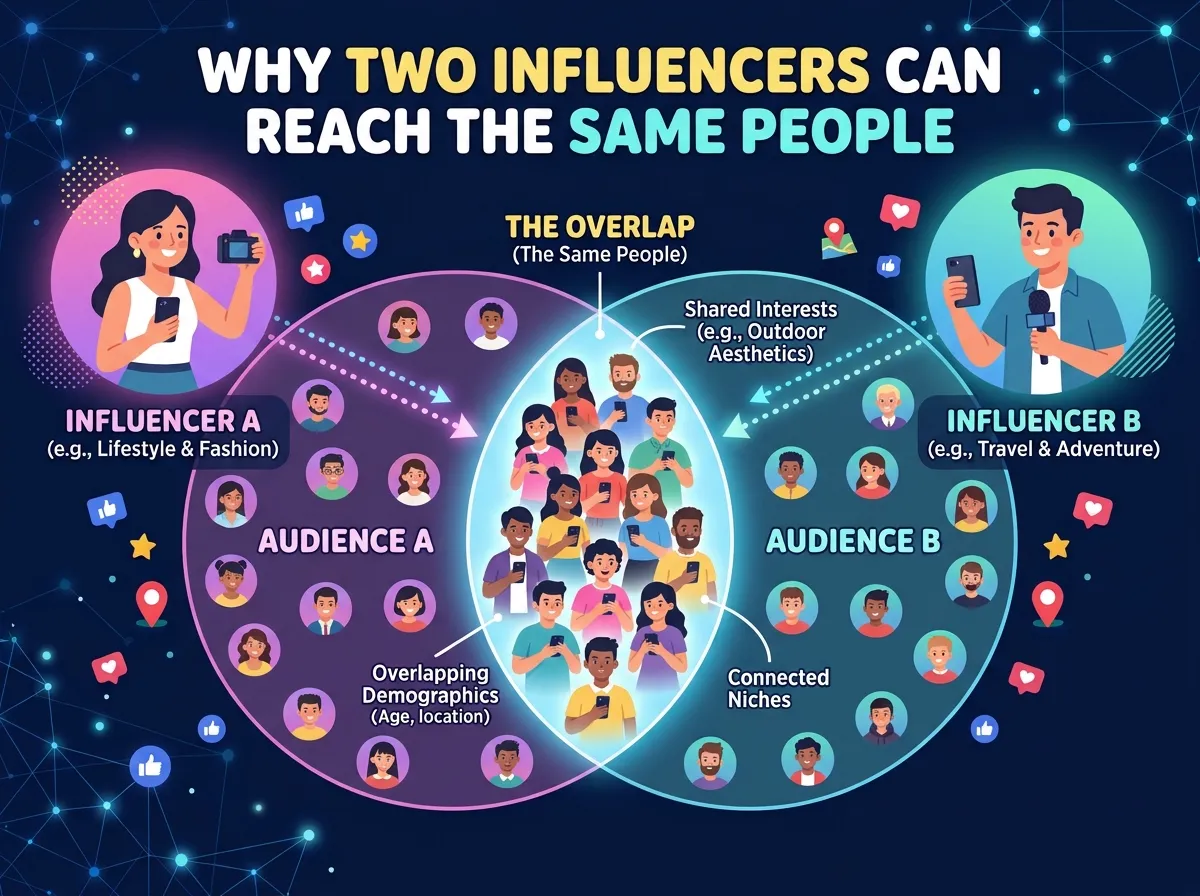
Influencer audiences often develop around shared interests, communities, and content preferences. Creators who publish about similar subjects naturally attract some of the same followers.
For example, two fitness influencers may both appeal to people interested in home workouts, nutrition, and active lifestyles. Although their individual follower counts may be impressive, a portion of their audiences could consist of the same users.
The same pattern appears in beauty, technology, travel, fashion, gaming, and business content. People rarely follow only one creator within a category. They may subscribe to several accounts because they enjoy different personalities, perspectives, or content formats.
This creates Audience Overlap Between Influencers, which becomes particularly relevant when brands plan multi-creator campaigns.
Imagine a company collaborating with three lifestyle influencers. Each creator reports a large audience, but their followers may share similar demographic characteristics and interests. The campaign could generate strong visibility within one community while reaching fewer unique individuals than expected.
That does not make the partnerships ineffective. It simply means the brand needs to understand the relationship between individual reach and combined reach.
Influencer Audience Overlap Analysis: Looking Beyond Follower Counts
Follower counts provide a basic indication of an influencer’s potential audience, but they do not reveal how distinct that audience is from the audiences of other creators.
Influencer Audience Overlap Analysis examines the shared portion of influencer audiences to help brands understand the actual reach potential of a campaign.
This analysis can involve comparing audience identities where reliable platform or analytics data is available, examining audience interests, and reviewing demographic similarities. Some tools estimate shared followers or audience connections, while others provide broader similarity indicators based on available data.
The most useful analysis distinguishes between two concepts: audience size and audience uniqueness.
Audience size reflects the number of people a creator may reach individually. Audience uniqueness considers how many of those people are new when the creator is added to an existing campaign.
A creator with a smaller audience may offer greater incremental value if their followers are largely different from those already reached by the campaign.
For this reason, brands should not assume that the influencer with the largest follower count always contributes the greatest additional reach.
Influencer Audience Demographics Comparison and Campaign Fit
Audience overlap is not limited to identical followers. Influencers can also share similar audience characteristics even when their follower lists are different.
An Influencer Audience Demographics Comparison helps marketers understand whether creators attract people with similar age groups, geographic locations, interests, or other relevant characteristics.
For example, two fashion creators may have different followers but attract audiences with nearly identical purchasing preferences. A campaign featuring both may reinforce its message within the same market segment.
In some situations, this is exactly what a brand wants.
If the objective is to build awareness among a specific audience, working with creators who appeal to that group can increase message frequency and familiarity. However, if the campaign aims to expand into new markets, demographic similarity may limit its ability to reach additional customer segments.
The value of overlap therefore depends on campaign objectives.
A brand seeking broad market expansion may prefer creators with complementary audience profiles. A brand launching a specialized product may benefit from concentrated exposure among people who are already interested in the category.
Demographic comparison provides context for these decisions, but it should not replace an evaluation of audience quality, engagement, and relevance.
Creator Audience Similarity Analysis: More Than Shared Followers
Two influencers can have little direct follower overlap and still attract remarkably similar audiences.
Creator Audience Similarity Analysis examines the broader relationship between audiences, including their interests, content preferences, and engagement patterns.
For instance, one creator may focus on sustainable fashion while another produces lifestyle content about responsible consumption. Their followers may not be identical, but both audiences could respond positively to environmentally conscious products.
This kind of similarity can be useful for campaign planning because it reveals whether creators are likely to communicate with comparable communities.
Audience similarity can also help identify complementary partnerships. A technology influencer and a productivity creator may attract different follower groups while sharing an interest in tools that improve work efficiency.
The distinction is important: direct overlap measures shared individuals, while audience similarity describes how closely two communities resemble one another.
A campaign can have low direct overlap but high audience similarity. It can also have substantial shared followers while offering different content styles or levels of influence.
Both factors contribute to understanding the overall campaign opportunity.
Influencer Reach Overlap Measurement and the Meaning of Unique Reach
One of the most practical reasons to evaluate audience overlap is to understand how much additional reach each influencer contributes.
Influencer Reach Overlap Measurement helps brands estimate the difference between individual audience reach and the combined number of unique people reached by multiple creators.
A simplified example illustrates the concept.
Suppose two influencers each reach 100,000 people during a campaign. Their combined individual reach totals 200,000. However, if 30,000 people are reached by both creators, the campaign’s estimated unique reach would be 170,000 rather than 200,000.
The shared audience is not necessarily wasted. Those people may see the campaign more than once, which can improve recognition and recall. But the brand should understand that repeated exposure and additional reach are different outcomes.
When more creators are added, the calculation becomes more complicated because audience overlap can occur across several combinations.
Reliable measurement requires consistent data, clear reporting periods, and an understanding of how each platform defines reach. Estimated audience overlap should not be treated as an exact figure unless the underlying data supports that level of precision.
The goal is to develop a realistic picture of campaign exposure rather than relying on the sum of individual influencer metrics.
Shared Audience Insights for Influencers: Finding the Right Combination
Shared Audience Insights for Influencers can reveal useful patterns about how creators relate to one another.
A brand may discover that several influencers appeal to the same community, while another creator reaches a different segment with complementary interests.
These insights can help shape the structure of a campaign.
For example, a skincare brand might work with one creator who specializes in product education, another who focuses on daily routines, and a third who creates lifestyle content. Their audiences may overlap, but their different content approaches can give the campaign several ways to communicate its value.
Shared audience information can also support relationship planning. Creators who appeal to similar communities may be suitable for coordinated launches, recurring promotions, or content series.
However, brands should avoid assuming that audience overlap guarantees identical campaign performance. Different creators can influence the same people in different ways because of their credibility, tone, expertise, and relationship with followers.
Audience data is most useful when it supports creative judgment rather than replacing it.
Influencer Audience Duplication: When Repeated Reach Becomes Inefficient
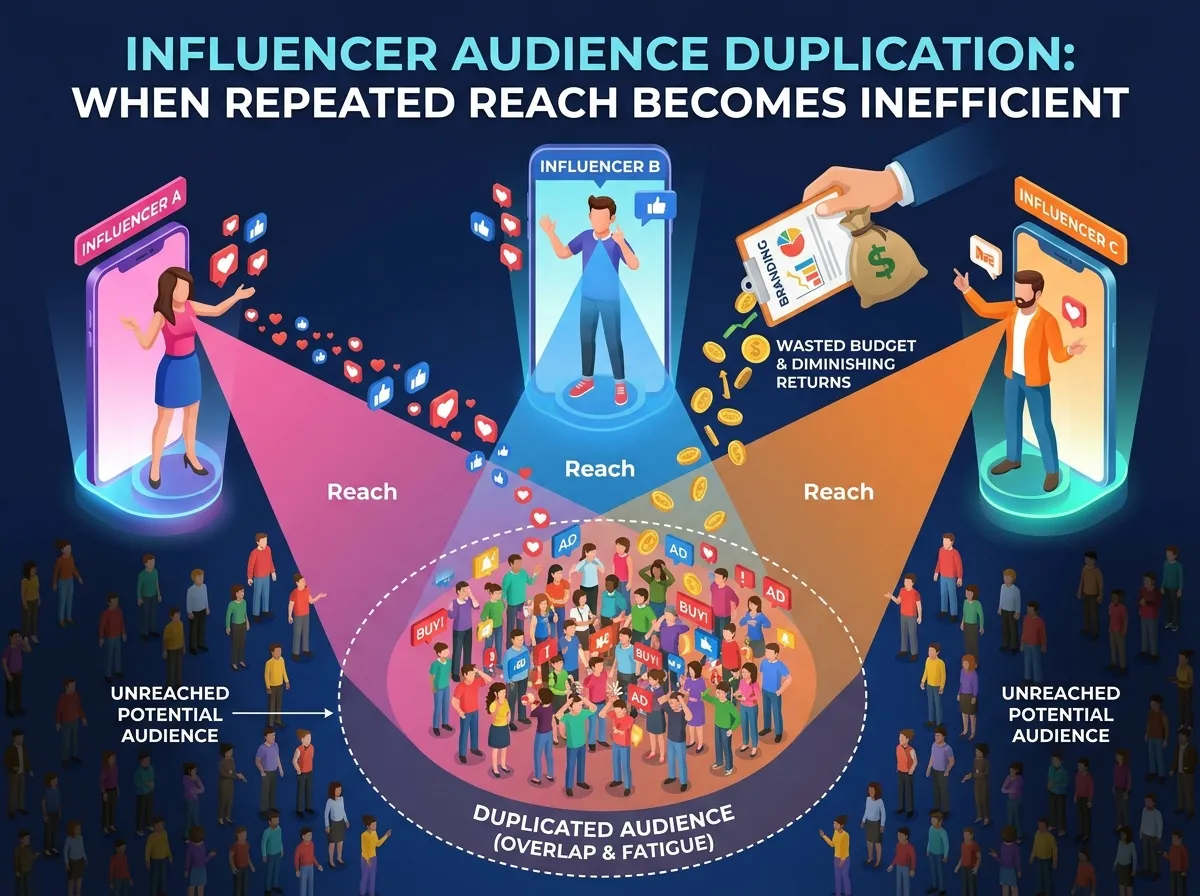
Influencer Audience Duplication occurs when a campaign repeatedly reaches the same individuals through multiple creators.
Some duplication is expected in influencer marketing. People often need to encounter a brand several times before they remember it or consider taking action.
The concern arises when repeated exposure becomes disproportionate to the campaign’s objectives.
For example, a campaign designed to introduce a new product to a broad audience may lose efficiency if most participating influencers reach the same followers. The brand could be investing in additional partnerships without significantly expanding its audience.
On the other hand, a campaign focused on building trust within a niche community may benefit from repeated exposure through familiar creators.
The distinction depends on the intended outcome.
Audience duplication should therefore be evaluated alongside frequency, engagement, brand recall, and conversion behavior. A campaign with higher duplication may still deliver strong results if the repeated messages encourage meaningful action.
The key is to understand whether additional exposure contributes to the campaign or simply increases the cost of reaching an already familiar audience.
Cross-Influencer Audience Analysis for More Balanced Campaigns
Cross-Influencer Audience Analysis examines the relationships among several creators rather than comparing them only in pairs.
This broader perspective is useful when brands plan campaigns involving multiple influencers across different platforms or content categories.
A group of creators may appear diverse based on follower counts and content styles, yet their audiences could be concentrated within a narrow demographic. Another group may have smaller individual audiences but provide stronger coverage across different communities.
Cross-influencer analysis can help identify these patterns.
It may reveal which creators contribute the greatest additional reach, which partnerships reinforce existing campaign exposure, and which audiences remain underrepresented.
This information can also support more balanced creator portfolios.
Instead of selecting influencers solely because they have strong individual performance, brands can consider how each creator contributes to the overall campaign structure.
The result is a more coordinated approach to influencer selection, where individual partnerships are evaluated in relation to the larger marketing objective.
Influencer Campaign Audience Overlap and Marketing Efficiency
Influencer Campaign Audience Overlap directly affects how brands interpret the efficiency of their influencer investments.
When several creators reach the same audience, campaign performance should be evaluated using more than total impressions or follower counts.
A useful comparison considers the cost of reaching unique people, the quality of engagement, and the contribution each influencer makes to the campaign.
For example, one creator may deliver substantial incremental reach at a relatively low cost. Another may reach fewer new people but generate stronger engagement among an audience that already recognizes the brand.
Both may provide value, but their roles are different.
Campaign efficiency also depends on the content itself. A creator with a highly overlapping audience may still produce a unique perspective that encourages followers to interact with the brand in a new way.
Brands can improve their understanding by comparing audience overlap with campaign outcomes, including website visits, product inquiries, tracked conversions, and other relevant indicators.
This approach helps move influencer marketing beyond simple reach calculations toward a more meaningful evaluation of business impact.
Audience Exclusivity in Influencer Marketing: The Role of Distinct Communities
Audience Exclusivity in Influencer Marketing refers to the extent to which a creator offers access to an audience that is not already heavily represented within a brand’s existing influencer partnerships.
Exclusivity can be valuable when a campaign aims to expand its reach into new communities or reduce unnecessary repetition.
However, exclusive audiences are not automatically better audiences.
A creator may reach a completely different group of people who have little interest in the brand’s products. Another influencer may share a substantial audience with existing partners but have a strong relationship with those followers.
The brand must therefore balance uniqueness with relevance.
Audience exclusivity is especially useful when evaluating partnerships for market expansion, product launches, or campaigns targeting new customer segments. Brands can also explore Influencer Marketing for Webinars to understand how creators can help attract relevant audiences and increase webinar reach.
It can also help brands understand whether their influencer portfolio has become too concentrated within one content category or community.
Using Technology to Understand Audience Relationships

As influencer campaigns become more complex, technology can help marketers organize audience information and evaluate creator relationships more efficiently.
Influencer marketing platforms may provide audience demographics, engagement analysis, campaign reporting, and estimated audience overlap. These capabilities can support faster comparisons and help teams identify potential duplication before finalizing partnerships.
Automation can also simplify campaign administration. Influencer Marketing Automation explores how technology can support campaign coordination and management, allowing marketers to focus more attention on strategy and performance.
Still, technology should be used carefully.
Audience estimates may vary between platforms, and privacy restrictions can limit the availability of individual-level data. Brands should avoid treating every similarity score as definitive evidence of shared followers.
The strongest analysis combines available data with creator knowledge, campaign objectives, and an understanding of the communities involved.
Creating a Smarter Influencer Portfolio
Influencer Audience Overlap is not simply a metric used to eliminate similar creators. It is a way to understand how different partnerships work together.
A thoughtful influencer portfolio may include creators with overlapping audiences when repeated exposure supports brand awareness. It may also include creators with distinct communities when the campaign needs broader reach or access to new customer segments.
The best combination depends on the brand’s goals, the relevance of each audience, and the contribution each creator makes to the campaign.
By examining audience overlap alongside demographics, engagement, content quality, and campaign performance, businesses can make more informed partnership decisions.
Ultimately, successful influencer marketing is not about reaching the largest number of people through the greatest number of creators. It is about reaching the right people with meaningful messages and building relationships that support lasting brand value.
Frequently Asked Questions
1. What is Influencer Audience Overlap?
Influencer Audience Overlap refers to the portion of people who follow or are reached by more than one influencer within a campaign or creator group.
2. Why is influencer audience overlap important?
It helps brands understand their actual combined reach, identify duplicated exposure, and evaluate whether multiple influencer partnerships contribute distinct audience value.
3. How is influencer audience overlap analysis performed?
It can involve comparing shared follower data, audience demographics, interests, engagement patterns, and estimated unique reach using available analytics tools.
4. Does audience overlap always reduce campaign performance?
No. Overlap can support repeated exposure, brand familiarity, and trust. It becomes a concern when duplication limits campaign reach without contributing meaningful engagement or results.
5. What is the difference between audience overlap and audience similarity?
Audience overlap measures shared individuals, while audience similarity compares broader characteristics such as interests, demographics, and content preferences.
6. How can brands measure influencer reach overlap?
Brands can compare individual reach with estimated combined unique reach, accounting for the people exposed to multiple influencers.
7. What is influencer audience duplication?
Influencer audience duplication occurs when multiple creators reach the same people. It may be useful for repeated messaging but can reduce incremental reach in campaigns focused on audience expansion.
8. How does cross-influencer audience analysis help?
It reveals how creators relate to one another across a campaign, helping brands identify complementary audiences and understand which partnerships contribute additional reach.
9. What is audience exclusivity in influencer marketing?
Audience exclusivity describes how distinct a creator’s audience is from the audiences already represented in a brand’s influencer portfolio.
10. Can influencer marketing tools identify audience overlap?
Many influencer marketing platforms offer audience comparison or overlap estimates. Results should be interpreted carefully because data availability and measurement methods can vary.